Table of Contents
Red Tapu vs. Blue Tapu in Turkey
Turkey's real estate market has become one of the most attractive investment destinations for international buyers. Whether purchasing an apartment in Istanbul, a villa on the Mediterranean coast, a commercial property, or a piece of agricultural land, one document is more important than any other: the Tapu, also known as the Turkish Title Deed.
The Tapu is the official legal document that proves ownership of a property or land parcel. It is issued by the General Directorate of Land Registry and Cadastre (TKGM) and serves as the only legally recognized proof of ownership in Turkey.
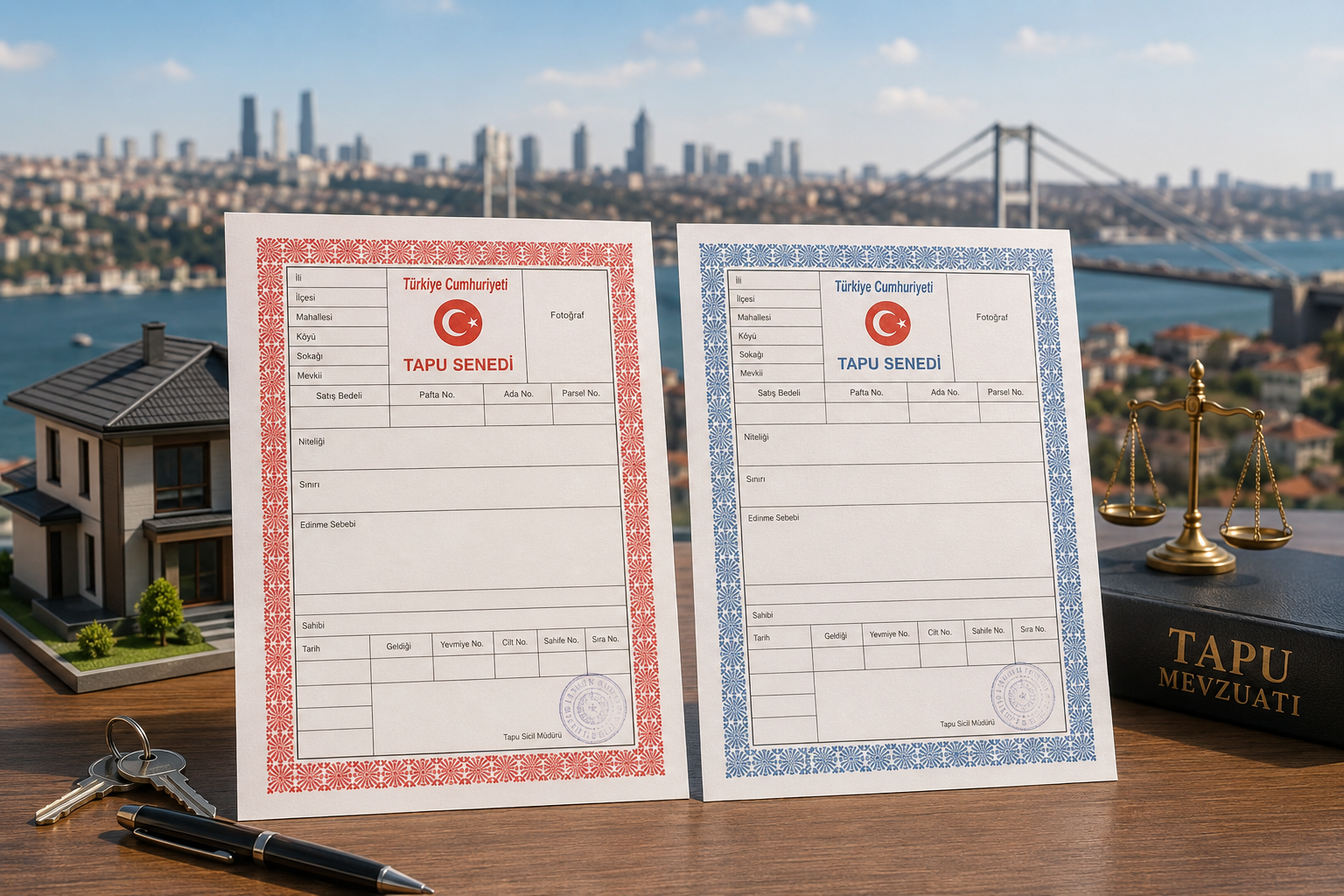
One of the first things foreign investors notice is that Turkish title deeds come in different colors, with the Red Tapu and Blue Tapu being the two most common types.
This often leads to several important questions:
What is the difference between the Red Tapu and the Blue Tapu?
Is one better than the other?
Can foreigners own both types?
Does the color affect property value?
Which type is better for investment?
Does the title deed color affect Turkish residency or citizenship applications?
Understanding these differences is essential before making any real estate investment decision.
Contrary to popular belief, the color of the Tapu does not determine the strength of ownership rights. Instead, it identifies the legal classification of the property registered with the Turkish Land Registry.
Choosing the right property requires understanding not only the market value and location but also the legal nature of the title deed.
What Is a Tapu in Turkey?
A Tapu (Tapu Senedi) is the official title deed issued by the Turkish government that certifies ownership of a property or parcel of land.
Once ownership is transferred and registered at the Land Registry Office, the buyer becomes the legal owner of the property under Turkish law.
The Tapu contains detailed information, including:
Owner's full name
Province, district, and neighborhood
Parcel and plot numbers
Property type
Land size or apartment size
Ownership share
Registration date
Official registry information
Property registration reference numbers
Without a registered Tapu, ownership is not legally complete, regardless of any private sales contract or payment receipt.
This is why experienced real estate lawyers always advise buyers to ensure that ownership is officially transferred through the Turkish Land Registry rather than relying solely on contracts.
Why Are There Different Colors of Tapu?
The Turkish Land Registry uses different colors to distinguish between different categories of real estate.
The two primary types are:
Red Tapu
Blue Tapu
The distinction is administrative rather than legal.
The color simply identifies whether the registered asset is:
A completed or residential/commercial building.
A parcel of land or agricultural property.
Therefore, the color itself does not indicate that one title deed provides stronger ownership rights than the other.
Instead, each title deed corresponds to a different legal classification with different regulations concerning:
Construction rights
Land usage
Development permissions
Property transfer procedures
Investment opportunities
For this reason, professional investors always evaluate the property's legal status rather than relying solely on the title deed color.
Why Should Investors Understand the Difference?
For anyone considering purchasing real estate in Turkey, understanding the difference between the Red and Blue Tapu is an essential part of due diligence.
The type of title deed affects several practical aspects of ownership, including:
The intended use of the property
Development opportunities
Financing options
Future resale potential
Rental opportunities
Compliance with zoning regulations
Long-term investment strategy
It also helps buyers avoid costly legal mistakes, particularly when purchasing land with future development plans.
Banks, mortgage providers, lawyers, and property valuation experts also take the title deed type into consideration during financing and legal assessments.
Does the Tapu Color Affect Property Value?
One of the most common misconceptions is that a Red Tapu automatically means a property is more valuable than a Blue Tapu.
This is not true.
The value of any real estate asset depends on numerous factors, including:
Location
Accessibility
Infrastructure
Demand
Property condition
Zoning status
Development potential
Market trends
For example, a Blue Tapu agricultural land located in an expanding urban area may appreciate significantly over time, while a Red Tapu apartment in a less desirable location may experience slower growth.
Therefore, investors should evaluate the entire investment opportunity rather than focusing on the color of the title deed.
Why Foreign Buyers Should Pay Attention
Foreign investors often purchase property in Turkey for several reasons:
Residential living
Rental income
Holiday homes
Long-term capital appreciation
Turkish residency
Turkish citizenship by investment (subject to the applicable legal requirements)
Each investment objective may favor a different type of property.
A buyer seeking immediate rental income will typically prefer a completed apartment with a Red Tapu, while an investor planning long-term land appreciation may choose a Blue Tapu property after carefully reviewing zoning regulations and legal restrictions.
Understanding these distinctions before signing a purchase agreement can save both time and money while ensuring a secure and legally compliant investment.
What Is the Red Tapu in Turkey?
The Red Tapu (Kırmızı Tapu) is the most common type of title deed in Turkey and is typically issued for constructed properties such as apartments, villas, offices, shops, warehouses, and other independent units within residential or commercial buildings.
For both Turkish citizens and foreign investors, the Red Tapu represents the standard title deed received when purchasing a completed property or a unit within a licensed real estate development.
Today, the majority of residential and commercial real estate transactions in Turkey involve properties with a Red Tapu.
Why Is It Called the Red Tapu?
The name comes from the red-colored cover traditionally used by the Turkish Land Registry for title deeds associated with buildings and independent property units.
The color itself has no legal advantage over any other title deed.
Instead, it simply serves as an administrative classification that helps distinguish built properties from land registered under different title deed categories.
When Is a Red Tapu Issued?
A Red Tapu is generally issued in the following situations:
Purchasing a completed apartment.
Buying a detached villa.
Purchasing an office.
Buying a commercial shop.
Purchasing a warehouse.
Buying an independent unit within a residential complex.
Purchasing an off-plan property with registered construction servitude.
Registering full ownership after the building receives its occupancy permit.
After all legal transfer procedures are completed, the new owner is officially registered in the Turkish Land Registry.
Types of Red Tapu
Many foreign buyers assume that every Red Tapu represents exactly the same legal status.
However, Turkish property law recognizes two main categories.
Understanding the difference is extremely important because each category represents a different stage in the property's legal development.
Construction Servitude (Kat İrtifakı)
Construction Servitude is issued for licensed buildings that are still under construction or have not yet obtained their final occupancy permit.
This title deed legally identifies each future independent unit within the project while construction is ongoing.
It confirms that the owner has legal rights to a specific apartment, office, or commercial unit according to the approved architectural plans.
This type of title deed is extremely common in newly launched residential projects throughout Turkey.
Main Characteristics
Issued before construction is fully completed.
Based on an officially approved building permit.
Identifies the future independent unit.
Can be legally transferred and sold.
Frequently used by real estate developers.
Later converted into Condominium Ownership after completion.
Suitable for purchasing off-plan properties.
Advantages of Construction Servitude
Buying a property under Construction Servitude can offer several advantages, including:
Lower purchase prices during construction.
Higher capital appreciation potential.
Flexible payment plans.
Early access to premium projects.
Opportunity to choose preferred apartment layouts.
Possibility of higher resale value after project completion.
However, buyers should always verify the developer's reputation and ensure that all construction permits are legally approved.
Condominium Ownership (Kat Mülkiyeti)
Condominium Ownership represents the highest level of property ownership in Turkey.
It is issued only after:
Construction is fully completed.
The building complies with all regulations.
The municipality grants the Occupancy Permit (İskan).
Every independent unit is officially registered.
This title deed confirms complete and permanent ownership of an individual property.
Because it represents the final legal stage, it is generally preferred by:
Homebuyers.
Banks.
Mortgage providers.
Institutional investors.
International buyers.
Advantages of Condominium Ownership
Properties with Condominium Ownership offer numerous benefits:
Full legal ownership.
Independent title registration.
Easier resale.
Better mortgage eligibility.
Higher buyer confidence.
Greater legal security.
Easier inheritance procedures.
Stronger market demand.
Clear ownership boundaries.
For investors seeking stable long-term assets, this is generally considered the safest form of ownership.
Construction Servitude vs. Condominium Ownership
|
Feature |
Construction Servitude (Kat İrtifakı) |
Condominium Ownership (Kat Mülkiyeti) |
|
Building Status |
Under construction |
Completed |
|
Building Permit |
Yes |
Yes |
|
Occupancy Permit (İskan) |
Not yet issued |
Issued |
|
Property Transfer |
Allowed |
Allowed |
|
Mortgage Availability |
Limited in some cases |
Widely accepted |
|
Legal Security |
High |
Highest |
|
Buyer Preference |
Investors |
Homebuyers & Investors |
Main Benefits of the Red Tapu
The Red Tapu is popular because it provides a high level of legal protection and offers owners clear property rights recognized throughout Turkey.
Some of its major advantages include:
Official proof of ownership.
Easy property transfer.
Mortgage eligibility.
Strong legal protection.
High resale demand.
Suitable for rental income.
Widely accepted by financial institutions.
Recognized by all public authorities.
Facilitates inheritance procedures.
Clearly defines ownership shares.
Can Foreigners Own a Red Tapu?
Yes.
Foreign nationals are legally permitted to purchase properties with a Red Tapu, provided they comply with Turkish real estate regulations.
General requirements include:
The property must not be located in a restricted military or security zone.
Ownership limits applicable to foreign nationals must be respected.
Official title transfer procedures must be completed.
Property valuation requirements must be fulfilled where legally required.
Taxes and registration fees must be paid.
Once the transfer is completed, the foreign buyer enjoys the same ownership rights as any other legal property owner under Turkish law.
Is the Red Tapu Suitable for Investment?
For most international buyers, the answer is yes.
A Red Tapu is ideal for investors seeking:
Residential apartments.
Family homes.
Holiday properties.
Commercial offices.
Retail shops.
Rental income.
Long-term capital appreciation.
Relatively lower investment risk.
Easier resale opportunities.
Financing through Turkish banks.
It is also commonly associated with investments that may qualify for residency or Turkish citizenship by investment, provided all applicable legal requirements in force at the time of purchase are satisfied.
Who Should Choose a Red Tapu?
The Red Tapu is generally the best choice for buyers who want to:
Move into the property immediately.
Generate rental income.
Purchase a ready-to-use apartment or villa.
Obtain mortgage financing.
Invest in established residential developments.
Minimize legal and investment risks.
Buy property in major Turkish cities such as Istanbul, Ankara, Izmir, Bursa, Antalya, or Mersin.
For these reasons, the Red Tapu remains the preferred option for the majority of foreign real estate investors entering the Turkish property market.
What Is the Blue Tapu in Turkey?
The Blue Tapu (Mavi Tapu) is the official title deed generally used for land properties rather than completed buildings.
Unlike the Red Tapu, which represents ownership of independent residential or commercial units, the Blue Tapu is commonly issued for:
Agricultural land
Empty plots
Orchards
Farms
Vineyards
Undeveloped land
Rural properties
Certain investment lands awaiting future development
The Blue Tapu is an official document issued by the General Directorate of Land Registry and Cadastre (TKGM) and carries the same legal validity as the Red Tapu.
The difference lies in the type of real estate being registered, not in the legal strength of the ownership.
Why Is It Called the Blue Tapu?
The title deed is commonly referred to as the Blue Tapu because of its blue cover, which has traditionally been used by the Turkish Land Registry for land ownership records.
The color itself has no impact on:
Ownership rights
Legal protection
Transfer procedures
Property registration
It simply identifies that the registered asset is generally a parcel of land rather than a completed building.
What Types of Property Receive a Blue Tapu?
A Blue Tapu may be issued for several categories of land, including:
Agricultural land
Farming land
Orchards
Olive groves
Vineyards
Pastures (subject to applicable regulations)
Rural land
Investment land
Undeveloped plots
Certain land parcels outside municipal development plans
Some of these lands may become suitable for construction in the future if zoning plans change.
However, this should never be assumed without official confirmation from the relevant municipality.
Can You Build on Land with a Blue Tapu?
This is one of the most frequently asked questions by foreign investors.
The short answer is:
Not necessarily.
Owning land with a Blue Tapu does not automatically grant the right to build residential or commercial buildings.
Construction rights depend on several legal factors, including:
Current zoning status
Municipal development plans
Land-use classification
Building density regulations
Agricultural protection laws
Municipality approvals
Environmental restrictions
Infrastructure availability
Before purchasing any land for development, investors should always obtain official zoning information from the local municipality.
Never rely solely on verbal promises from sellers or intermediaries.
Can Foreigners Buy Land with a Blue Tapu?
Yes.
Foreign nationals are allowed to purchase certain types of land in Turkey, provided they comply with Turkish property laws.
Generally, buyers must ensure that:
The land is outside restricted military and security zones.
Ownership limits for foreign nationals are respected.
Registration procedures are completed correctly.
Required governmental approvals are obtained where applicable.
The intended use complies with Turkish regulations.
Depending on the property's location and purpose, additional legal procedures may apply.
Professional legal advice is highly recommended before purchasing agricultural or undeveloped land.
Advantages of the Blue Tapu
Although the Red Tapu is more common among residential buyers, the Blue Tapu offers several attractive investment opportunities.
Major advantages include:
Lower purchase prices compared to developed properties.
Excellent long-term appreciation potential.
Suitable for agricultural investment.
Opportunity to diversify an investment portfolio.
Potential future development opportunities.
Strong capital growth in expanding urban regions.
Lower maintenance costs compared to completed buildings.
Flexible long-term investment strategies.
For experienced investors, land investments can generate substantial returns over time, especially in regions undergoing infrastructure expansion.
Disadvantages of the Blue Tapu
Despite its advantages, investors should also understand the potential risks.
Possible disadvantages include:
Construction may not be permitted.
Development approvals can take years.
Municipal zoning plans may change.
Some land may remain agricultural indefinitely.
Financing options may be more limited.
Resale may require a longer investment horizon.
Legal due diligence is essential before purchase.
These risks make careful legal and technical investigations extremely important.
When Is the Blue Tapu the Right Investment?
A Blue Tapu is often suitable for investors who wish to:
Purchase agricultural land.
Invest in long-term land appreciation.
Develop agricultural businesses.
Diversify their investment portfolio.
Acquire strategically located land before urban expansion.
Hold property for future development opportunities.
It is generally less suitable for buyers seeking:
Immediate residential use.
Rental income.
Short-term investment returns.
Ready-to-use commercial properties.
Comparison Table: Red Tapu vs. Blue Tapu
|
Feature |
Red Tapu |
Blue Tapu |
|
Property Type |
Apartments, Villas, Offices, Shops |
Agricultural & Undeveloped Land |
|
Primary Purpose |
Residential & Commercial Use |
Agricultural & Land Investment |
|
Ready for Occupancy |
Yes |
No |
|
Rental Potential |
High |
Generally Limited |
|
Construction Rights |
Usually Available (subject to permits) |
Depends on zoning regulations |
|
Mortgage Availability |
High |
More Limited |
|
Investment Horizon |
Short, Medium & Long Term |
Mostly Long Term |
|
Foreign Ownership |
Allowed (subject to regulations) |
Allowed (subject to regulations) |
|
Capital Appreciation |
Stable |
Potentially High |
|
Risk Level |
Low to Medium |
Medium to High |
Common Misconceptions About Blue and Red Tapu
Many first-time buyers misunderstand the purpose of different Turkish title deeds.
Some of the most common misconceptions include:
The Red Tapu Is Legally Stronger Than the Blue Tapu
This is incorrect.
Both title deeds are official legal documents issued by the Turkish Land Registry and provide full ownership rights according to Turkish law.
Every Blue Tapu Land Can Be Developed
False.
Construction rights depend entirely on:
Municipal zoning plans
Land classification
Environmental regulations
Government approvals
Red Tapu Properties Always Generate Higher Returns
Not necessarily.
A strategically located Blue Tapu land parcel may experience significantly greater appreciation than a completed apartment over the long term.
Investment performance depends on:
Location
Market demand
Infrastructure
Future development
Economic conditions
Buying Agricultural Land Is Simpler Than Buying Apartments
In reality, purchasing land often requires more extensive legal due diligence, particularly regarding:
Zoning status
Agricultural restrictions
Easements
Utility access
Future development permissions
The Color Determines Property Value
Another common misconception.
The market value of any property depends on factors such as:
Location
Accessibility
Infrastructure
Demand
Development potential
Market conditions
The title deed color merely identifies the legal classification of the registered property.
Comprehensive Comparison Between the Red Tapu and Blue Tapu
After understanding the legal definitions and characteristics of both title deed types, the next question naturally arises:
Which title deed is the better investment?
The answer depends entirely on your investment objectives.
Neither the Red Tapu nor the Blue Tapu is inherently better than the other. Each serves a different legal purpose and is suitable for different types of investors.
If your goal is purchasing a ready-to-live apartment, generating rental income, or buying commercial property, the Red Tapu is generally the preferred option.
On the other hand, if your strategy focuses on land banking, agricultural investment, or long-term capital appreciation, a Blue Tapu may provide greater opportunities.
Choosing the correct title deed should always be based on your investment strategy rather than the color of the document.
Legal Comparison
From a legal perspective, both title deeds carry the same legal authority because they are issued by the General Directorate of Land Registry and Cadastre (TKGM).
Both documents officially certify ownership under Turkish law.
However, the legal rights associated with each property differ according to the property's classification.
Red Tapu
Represents ownership of:
Apartments
Villas
Commercial units
Offices
Warehouses
Independent residential units
Blue Tapu
Represents ownership of:
Agricultural land
Empty plots
Rural properties
Investment land
Orchards
Farms
The distinction is therefore based on property type, not ownership validity.
Investment Comparison
Each title deed supports a different investment model.
Red Tapu is ideal for investors seeking:
Immediate occupancy
Stable rental income
Residential investment
Commercial leasing
Lower investment risk
Easier resale
Mortgage financing
Predictable cash flow
Blue Tapu is ideal for investors seeking:
Long-term appreciation
Land investment
Agricultural business
Strategic land acquisition
Portfolio diversification
Future development opportunities
Lower initial purchase prices
Financing Comparison
Turkish banks generally favor completed residential properties.
For this reason:
Red Tapu
Typically offers:
Easier mortgage approval
Higher financing ratios
Faster loan processing
Better collateral value
Especially when the property has Condominium Ownership (Kat Mülkiyeti).
Blue Tapu
Mortgage availability depends on:
Land classification
Intended use
Location
Bank policy
Property valuation
Some banks provide financing for land purchases, while others apply stricter lending conditions.
Liquidity Comparison
Liquidity refers to how quickly an asset can be sold.
Generally:
Red Tapu Properties
Offer:
Higher buyer demand
Faster resale
Stronger rental market
More stable pricing
Greater financing availability
Blue Tapu Properties
May require:
Longer holding periods
More specialized buyers
Additional legal verification
Greater market research
However, land located near expanding urban areas can experience exceptional appreciation.
Risk Comparison
Every real estate investment carries some level of risk.
The nature of those risks differs between the two title deed types.
Potential Risks of Red Tapu
Purchasing before verifying legal permits.
Existing mortgages or liens.
Construction quality issues.
Developer-related problems.
Incomplete documentation.
Potential Risks of Blue Tapu
Land not approved for construction.
Future zoning uncertainty.
Agricultural restrictions.
Environmental regulations.
Longer investment horizon.
Limited infrastructure.
Conducting comprehensive legal due diligence significantly reduces these risks.
Detailed Comparison Table
|
Comparison Factor |
Red Tapu |
Blue Tapu |
|
Property Type |
Residential & Commercial Buildings |
Agricultural & Undeveloped Land |
|
Primary Use |
Living, Renting, Business |
Agriculture & Long-Term Investment |
|
Ready to Use |
Yes |
No |
|
Rental Income |
Excellent |
Generally Limited |
|
Construction Rights |
Usually Available |
Depends on Zoning |
|
Mortgage Eligibility |
High |
Varies |
|
Resale Speed |
Fast |
Moderate |
|
Investment Risk |
Low to Medium |
Medium to High |
|
Long-Term Appreciation |
Good |
Potentially Excellent |
|
Foreign Buyer Friendly |
Yes |
Yes (subject to regulations) |
|
Suitable for Residence |
Yes |
Usually No |
|
Suitable for Commercial Investment |
Yes |
Depends on Land Classification |
|
Maintenance Costs |
Higher |
Lower |
|
Liquidity |
High |
Moderate |
How to Choose the Right Title Deed
Before purchasing any property in Turkey, ask yourself several important questions.
Choose a Red Tapu if you want:
A family home.
A holiday apartment.
Rental income.
Commercial property.
Mortgage financing.
Immediate occupancy.
Stable investment.
Easier resale.
Choose a Blue Tapu if you want:
Agricultural investment.
Land banking.
Long-term appreciation.
Future development opportunities.
Strategic land acquisition.
Portfolio diversification.
Important Tips Before Buying Property in Turkey
Regardless of which title deed you choose, following these best practices can help protect your investment.
Verify the Title Deed
Always confirm that the title deed is genuine and officially registered.
Check for Mortgages or Liens
Ensure the property has no:
Mortgages
Court restrictions
Seizures
Legal disputes
Ownership conflicts
Review Zoning Information
Especially when purchasing Blue Tapu land, obtain official zoning documentation from the municipality.
Never rely solely on verbal statements.
Work With Qualified Professionals
Consider hiring:
A licensed real estate agency.
A property lawyer.
A certified translator.
A valuation expert.
Professional guidance significantly reduces legal risks.
Verify Building Documentation
For Red Tapu properties, confirm:
Building Permit
Occupancy Permit (İskan)
Condominium Ownership status
Municipal approvals
Calculate All Purchase Costs
Remember to include:
Title deed transfer tax
Legal fees
Property valuation fees
Translation costs
Notary fees (where applicable)
Agency commissions
Annual property taxes
A complete budget prevents unexpected expenses.
Does the Color of the Tapu Affect Property Value?
Absolutely not.
Property prices are influenced by numerous factors, including:
Location
Neighborhood quality
Transportation access
Infrastructure
Property condition
Supply and demand
Investment potential
Economic conditions
Future development plans
The title deed color simply identifies the legal category of the registered property.
For example, a strategically located Blue Tapu land parcel near a future metro line may outperform a Red Tapu apartment in a less desirable area.
Professional investors therefore evaluate the entire investment profile, not merely the title deed classification.
Both the Red Title Deed and the Blue Title Deed are essential parts of the real estate registration system in Turkey, and neither one can be considered absolutely better than the other, as each type serves a different legal and investment purpose.
The success of a real estate investment does not depend on the color of the title deed, but rather on carefully studying the property or land, understanding the applicable laws and regulations, verifying the legal and zoning status, and choosing an investment that aligns with your financial and personal goals.
Therefore, obtaining professional real estate and legal consultation before completing the purchase process is a smart step that helps protect your capital, reduce risks, and achieve the best possible return on investment.
FAQ
The main difference is that the Red Title Deed (Kat Mülkiyeti) proves full ownership of an independent real estate unit, such as an apartment, office, or commercial shop within a completed and officially approved building. On the other hand, the Blue Title Deed (Kat İrtifakı) indicates ownership rights connected to a share in a project or building that is still under construction or has not yet obtained the occupancy permit (İskan).
Yes, the Red Title Deed is generally considered stronger from a legal perspective because it confirms that the property is completed and that all official procedures have been finalized. It also provides greater clarity when selling the property, transferring ownership, or applying for bank financing. However, having a Blue Title Deed does not necessarily mean there is a problem. It may simply indicate that the property is part of a new project or a recently developed building that is still completing legal procedures.
Yes, it is legally possible to purchase a property with a Blue Title Deed, especially in newly developed real estate projects. However, buyers should verify the project's status, construction permits, developer's reputation, and the expected timeline for obtaining the occupancy permit and converting the title deed into a Red Title Deed. It is always recommended to check the property records at the Land Registry Office and consult a real estate expert or specialized lawyer before completing the purchase.