Table of Contents
Could Kanal Istanbul Reshape the City's Property Market?
Istanbul is one of Turkey's most important real estate markets, supported by its strategic location, large population, economic activity and continuing investment in transport and urban infrastructure. However, property investment opportunities vary considerably between districts, depending on accessibility, local amenities, housing demand, construction quality and the availability of employment opportunities.
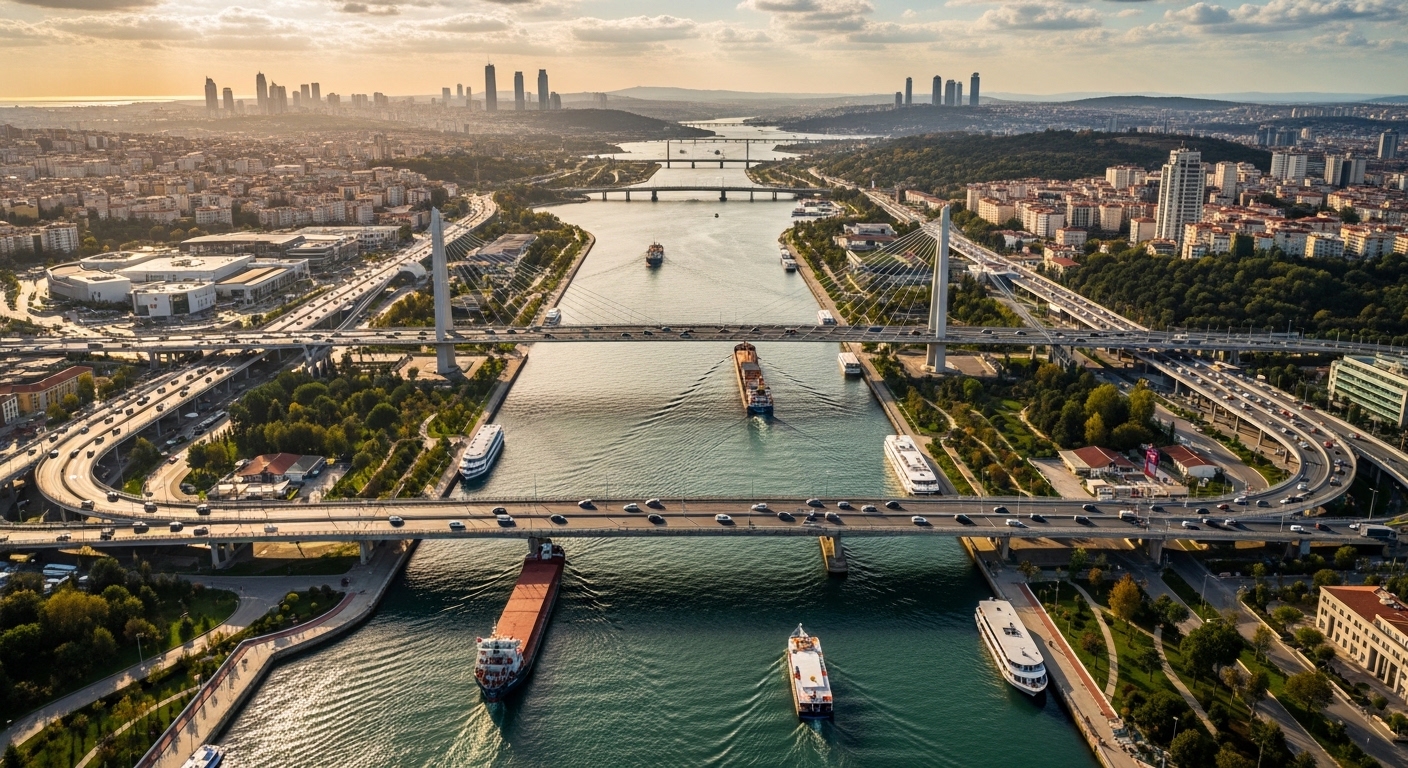
One development that continues to attract attention is the Kanal Istanbul project, a proposed artificial waterway intended to connect the Black Sea with the Sea of Marmara through the European side of Istanbul.
The Turkish Directorate General of Infrastructure Investments identifies the proposed route as approximately 45 kilometres long, running through the Küçükçekmece–Sazlıdere–Durusu corridor. AYGM
For property investors, the project matters for more than its maritime function. Expectations surrounding new residential districts, transport infrastructure, commercial facilities and urban expansion have encouraged interest in land and housing across parts of northwestern Istanbul.
However, an important distinction must be made between a project's potential impact and its confirmed economic outcomes.
Proximity to Kanal Istanbul does not automatically guarantee property appreciation.
Prices may rise in locations that gain better transport connections, employment opportunities and genuine housing demand. Conversely, properties priced mainly on speculative expectations may underperform if construction is delayed, planning assumptions change or demand fails to meet expectations.
As of October 2026, recent reporting indicates that planning, engineering and infrastructure-related activities are continuing around the proposed development area, while excavation of the canal itself has not begun. A report published on 16 October 2026 did not identify a confirmed date for a construction tender or the start of canal excavation. Turkish Minute
This makes it essential to distinguish between the value a property has today and the additional value it might gain if future development proceeds as anticipated.
What Is the Kanal Istanbul Project?
Kanal Istanbul is a proposed artificial waterway on Istanbul's European side, designed to create a new navigable connection between the Black Sea and the Sea of Marmara.
The proposed corridor is associated with wider urban development plans involving residential areas, infrastructure and supporting facilities.
For real estate investors, four factors explain much of the project's appeal.
New Residential Development
Large urban projects can encourage the development of housing, retail facilities, public spaces and supporting infrastructure.
If these developments produce well-connected, fully serviced neighbourhoods, nearby properties may benefit from stronger demand.
However, increasing the housing supply does not automatically increase property prices. If construction exceeds population growth and genuine demand, landlords and sellers may face greater competition.
Transport Infrastructure
Roads, metro connections and improved access to employment centres can affect property values by making locations more convenient for residents and businesses.
The key is to distinguish between completed infrastructure, projects under construction and proposals that remain uncertain.
Investors should verify the operational status of individual transport projects rather than relying on promotional maps showing future connections.
Land Investment
Land near major infrastructure projects often attracts speculative interest before construction begins.
Investors may expect future planning changes or increased demand to raise the value of their holdings.
Yet land can be significantly riskier than a completed apartment. Ownership rights, zoning status, permitted construction and environmental restrictions must be checked independently.
An attractive location does not automatically mean that a plot is suitable for residential development.
Urban Expansion
Istanbul's European side has experienced substantial residential and infrastructure development over the years.
Some districts may continue to benefit from this expansion even if Kanal Istanbul is delayed or implemented differently from its original plans.
For investors, this creates an important distinction: properties supported by existing infrastructure and established demand may be less dependent on the canal's completion than properties whose value rests almost entirely on the proposed waterway.

What Is the Project's Status in 2026?
Understanding the project's status is essential before making an investment decision.
The official infrastructure authority describes a programme involving route studies, engineering assessments, environmental evaluation, preliminary designs and planning for construction and associated infrastructure. The authority also records a positive environmental impact assessment decision dated 17 January 2020 and the finalisation of certain planning documents for parts of the corridor. AYGM
These milestones should not be confused with the completion of construction.
In October 2026, reporting on government statements indicated that engineering and planning work was continuing. The same reporting noted that development activity in the surrounding area had included housing and infrastructure, while the canal excavation itself had not started. No confirmed construction tender date or excavation start date was provided. Turkish Minute
Three different forms of development therefore need to be considered:
Planning and engineering:Studies, environmental assessments, designs and zoning decisions.
Associated urban development:Housing, roads and other infrastructure that may progress independently of the canal.
Canal construction and operation:The actual construction of the waterway and its eventual use for navigation.
These activities do not necessarily progress at the same speed.
A new housing development near the proposed route does not, by itself, establish that the canal is about to be completed.
What Does This Mean for Investors?
A property that offers reasonable value, practical access and rental demand today may remain attractive even if the canal is delayed.
By contrast, an expensive plot with limited services and no established development rights may be difficult to justify if its price depends on the canal being built within a particular timeframe.
The prudent approach is to evaluate the property's current fundamentals first and treat any potential benefit from Kanal Istanbul as an additional consideration.
Arnavutköy: A Key District to Watch
Arnavutköyis one of the districts most frequently associated with the proposed canal and the wider development of northwestern Istanbul.
Its appeal is linked to a combination of available land, urban expansion, proximity to Istanbul Airport and the potential development of new residential and infrastructure projects.
However, Arnavutköy is not a uniform property market. Individual neighbourhoods and plots can differ substantially in terms of access, services, zoning and development potential.

Why Could Arnavutköy Benefit?
Urban expansion:New housing and supporting facilities could increase demand in locations that develop into established residential neighbourhoods.
Airport-related activity:Istanbul Airport may support demand for selected residential, commercial and logistics properties, depending on access and the needs of local workers and businesses.
Potential planning changes:Some sites could become more attractive if permitted land uses or infrastructure connections improve.
However, investors must not assume that agricultural land will automatically become residential land simply because it lies near the proposed canal.
What Are the Main Risks?
Risks include speculative pricing, limited services, uncertainty about future development rights and difficulties reselling land that does not have a clear permitted use.
Investors should also examine any restrictions related to environmental protection, water resources and local planning.
Investment assessment:Arnavutköy may suit investors seeking long-term growth who can tolerate uncertainty. Completed properties in established neighbourhoods may be more appropriate for buyers who require immediate rental income.
The exact location and legal status of the property are more important than the district's general reputation.
Başakşehir: A Market Supported by Established Residential Demand
Başakşehiroffers a different investment profile from many less-developed parts of northwestern Istanbul.
The district includes established residential areas, modern apartment complexes, public services and transport connections that can support housing demand independently of Kanal Istanbul.
This allows investors to evaluate properties using more tangible criteria, including accessibility, building quality, amenities and comparable rents.
Why Consider Başakşehir?
Established housing demand:A populated residential neighbourhood can attract buyers who intend to live in their homes rather than rely exclusively on future resale.
Local amenities:Schools, healthcare facilities, shopping areas and public spaces influence household decisions and may support long-term demand.
Comparable properties:Where similar homes are regularly sold or rented, investors can make more informed estimates of value and rental returns.
Could Kanal Istanbul Increase Prices in Başakşehir?
Some locations could benefit indirectly from wider urban development and improved transport connections, provided the relevant projects are delivered.
However, there is no basis for assuming that every neighbourhood will experience the same effect or that the canal alone will drive prices higher.
Rental performance also depends on the purchase price. A property bought at a substantial premium may deliver a disappointing yield even if rents increase.
Investment assessment:Başakşehir may appeal to buyers seeking a balance between residential usability and long-term appreciation potential, especially when a property has practical access to existing transport and services.
Küçükçekmece: Urban Location and Existing Housing Demand
Küçükçekmeceis an established urban district associated geographically with the proposed canal corridor.
Unlike less-developed areas farther northwest, parts of Küçükçekmece already have residential communities, commercial activity and connections to the wider city.
Its property market nevertheless varies significantly by neighbourhood, building quality and access to transport.
Why Is Küçükçekmece Worth Monitoring?
Existing residential areas provide a basis for evaluating actual housing demand.
A range of property types may offer options for different budgets.
Transport and urban improvement projects can influence accessibility.
Some locations are connected to the wider planning discussion surrounding Kanal Istanbul.
Is Being Close to the Canal Always an Advantage?
No.
A property close to the proposed route might attract marketing interest but could also face construction disruption, environmental concerns or planning restrictions.
Nor does proximity to a waterway guarantee a future water view. That depends on the exact location, permitted development, urban design and the availability of an unobstructed waterfront.
Investors should also examine structural safety, building maintenance and earthquake-related considerations.
Investment assessment:Küçükçekmece may suit buyers who prefer an established urban setting, provided they evaluate the specific neighbourhood and property rather than relying on the canal narrative alone.
Avcılar: Could the District Benefit Indirectly?
Avcılaris another European-side district whose property market is influenced by local amenities, transport access, waterfront locations and the condition of individual buildings.
Its potential relationship with Kanal Istanbul is better understood through wider urban planning and infrastructure effects than through an assumption that the district will automatically benefit from the canal.
What Should Investors Examine?
Building condition:The age, structural condition and relevant permits of a property should be assessed independently of its investment potential.
Accessibility:Homes with convenient connections to employment centres and public transport may appeal to a wider pool of tenants.
Local rental demand:Actual rents, vacancy periods, maintenance expenses and competing properties help establish whether an investment is financially viable.
Environmental and planning factors:Certain locations may require additional checks concerning land use, environmental conditions and development restrictions.
Investment assessment:Avcılar can be considered on its own residential merits, with any potential canal-related benefit treated as uncertain rather than guaranteed.
Sazlıdere and Yenişehir: Potential Opportunities with Greater Uncertainty
Areas around Sazlıdere are particularly important to the Kanal Istanbul discussion because of their relationship to the proposed route and associated urban development plans.
The term Yenişehiris used in the context of planned urban development associated with the wider project. However, it should not be treated as a guarantee of future property appreciation.
Different plots can have very different zoning status, permitted uses, access and infrastructure provision.
What Could Create Investment Potential?
If residential development, public facilities and transport infrastructure are delivered, selected locations could become more attractive to households and businesses.
Some properties may benefit from improved connections to other parts of Istanbul.
But these outcomes depend on actual implementation, service provision and sufficient demand to absorb new housing.
What Makes These Areas Riskier?
Key risks include:
Uncertainty over the timing of canal construction.
Possible changes or delays to development plans.
Restrictions on permitted land uses.
Speculative land prices.
Limited rental demand in locations lacking services.
Environmental and water-resource concerns.
The project has been the subject of sustained debate over its potential effects on water resources, agricultural land and ecosystems. Istanbul's public information platform on Kanal Istanbul presents analyses and concerns relating to these impacts. kanal.istanbul
Consequently, investors need to evaluate not only potential appreciation but also the legal, environmental and planning risks that could affect a property's future use.
Investment assessment:Selected properties may appeal to experienced investors who can tolerate uncertainty. However, land with unclear development rights requires independent legal review before any deposit or purchase commitment.
Comparing the Main Areas: Where Could Investors Find Opportunities?
The following table provides a qualitative assessment of the districts and locations discussed. It is not a statistical forecast or a guarantee of returns.
|
Area |
Main attractions |
Potential investment profile |
Relative risk |
|
Arnavutköy |
Urban expansion, airport proximity and parts of the proposed canal corridor |
Long-term growth in carefully selected locations |
Relatively high for speculative sites |
|
Başakşehir |
Residential amenities, apartment complexes and transport connections |
Housing demand and rental potential |
Moderate in comparison, depending on the property |
|
Küçükçekmece |
Established urban areas and varied housing stock |
Properties supported by existing demand |
Varies by neighbourhood and building |
|
Avcılar |
Local services, urban location and residential demand |
Existing residential property |
Depends on location and structural condition |
|
Sazlıdere and Yenişehir-related areas |
Potential future urban development |
Investment linked to planning and implementation |
High because of planning and execution uncertainty |
These risk categories are indicative rather than official ratings. A legally secure property in a higher-risk district may be a better investment than a poorly documented property in a district generally considered safer.
Three Possible Scenarios for Property Prices
The future effect of Kanal Istanbul can be considered through three broad scenarios. These are analytical possibilities, not predictions that any particular outcome will occur.
Scenario One: Construction Proceeds and Supporting Infrastructure Is Delivered
If the canal proceeds to full construction and associated residential, transport and public infrastructure is completed, selected areas could benefit from improved accessibility, additional economic activity and stronger housing demand.
Properties near completed amenities and well-connected neighbourhoods may be better positioned to benefit.
Even in this scenario, however, price appreciation would not be uniform. New housing supply, financing costs, construction expenses and the strength of local demand would continue to influence the market.
Scenario Two: Urban Development Continues While the Canal Is Delayed
Housing and some infrastructure projects may continue even if the canal itself is delayed.
Properties supported by existing transport, established neighbourhoods or independently viable development projects could still perform reasonably well.
This scenario highlights the value of buying an asset that remains useful without the waterway being completed.
Scenario Three: Prolonged Delays or Significant Changes to the Project
If construction is delayed for an extended period or plans change, expectations surrounding some speculative locations may weaken.
Land without clear development rights or sufficient local demand could become difficult to resell at the anticipated price.
By contrast, properties in established neighbourhoods may retain more of their relative appeal if they continue to serve genuine housing needs.
What Should Investors Learn from These Scenarios?
Rather than asking only whether Kanal Istanbul will be built, investors should consider several additional questions:
Is the property suitable for living in or renting out today?
Can its asking price be supported by comparable properties?
Are ownership and permitted land use clear?
Does the investment depend entirely on the canal?
Could the investor hold the property if construction were delayed for several additional years?
The clearer the answers, the less the investment depends on speculation.
Could Land Prices Rise Faster Than Apartment Prices?
Land can respond strongly to changes in zoning, permitted building density and infrastructure provision.
However, the same sensitivity that creates potential upside also increases exposure to speculation and regulatory uncertainty.
Investing in Land
A well-located plot with clear legal status may benefit from long-term development if infrastructure improves or permitted uses change.
Before buying, investors should verify ownership, zoning, construction rights, road access, easements and environmental restrictions.
Marketing materials and verbal assurances that agricultural land will eventually become residential land should not substitute for official documentation.
Investing in Completed Apartments
Completed apartments can be inspected and assessed for building condition, maintenance requirements and rental potential.
If located in an established neighbourhood, a property may generate income even if Kanal Istanbul is delayed.
However, rental income does not automatically make an apartment a good investment. The purchase price must be compared with realistic rental income after expenses, taxes, management costs and vacancy periods.
Investing in Off-Plan Properties
Properties under construction may offer flexible payment plans or modern specifications.
They also carry risks related to delivery delays, construction quality, developer solvency and contract terms.
Investors should review the developer's track record, project permits, payment protections, delivery obligations and cancellation provisions before committing funds.
The best property type depends on the investor's objectives.Land may suit a long-term investor who accepts substantial uncertainty, a completed apartment may suit someone seeking rental income, and an off-plan property requires additional scrutiny of the developer and contract.
Land, Completed Apartments or Off-Plan Property?
|
Property type |
Main potential advantage |
Principal risks |
Essential checks |
|
Land |
Potential to benefit from future development or changes in permitted use |
Zoning restrictions, speculation and resale difficulties |
Title deed, zoning, building rights and environmental restrictions |
|
Completed apartment |
Immediate use or potential rental income |
Maintenance costs, weak demand or overpricing |
Building condition, actual rents, title and running costs |
|
Off-plan apartment |
Potentially flexible payments and modern specifications |
Delivery delays, developer risk and contractual disputes |
Permits, developer record, guarantees and delivery terms |
|
Commercial property |
Potential to benefit from local business activity |
Vacancy and fluctuations in commercial demand |
Tenant demand, lease terms, local activity and operating costs |
How to Choose the Right Property in 2026
The most suitable investment depends on the buyer's goals, risk tolerance and time horizon.
If You Want Rental Income
Focus on properties with demonstrable tenant demand and convenient access to transport, services and employment centres.
Ask for evidence of achieved rents rather than relying only on advertised rental prices.
The gross rental yield can be calculated as follows:
Annual gross rental yield = Annual rental income ÷ Purchase price × 100
For example, assume an apartment costs €150,000 and generates the equivalent of €750 per month in rent.
Its annual rental income would be €9,000, producing a gross rental yield of 6%.
This is an illustrative calculation, not a reported market average for any Istanbul district. The net yield would be lower after maintenance, taxes, management expenses and vacancy periods.
If You Want Capital Appreciation
Study locations that could benefit from infrastructure improvements or the completion of established neighbourhoods.
However, avoid paying a large premium solely because a future project is expected to increase prices.
Compare asking prices with similar properties and assess how much of the property's current value depends on Kanal Istanbul.
If You Are Buying a Home
Daily convenience may be more important than speculative appreciation.
Consider commuting times, schools, healthcare, public transport, public spaces and the needs of your household.
If You Are Buying Land
Obtain independent advice from a Turkish real estate lawyer and verify the property's official planning status before paying a non-refundable deposit.
Do not rely solely on broker maps or verbal promises concerning future development rights.
Legal, Environmental and Economic Risks
Investors considering properties linked to Kanal Istanbul should evaluate several risks beyond ordinary price fluctuations.
Legal and Planning Risks
Check the title deed, registered ownership, permitted use, building rights and relevant restrictions.
Review any mortgages, liens, easements or third-party rights, and confirm that buildings have the necessary permits.
These checks are especially important when buying land or properties marketed primarily on their proximity to a proposed development.
Environmental Risks
Kanal Istanbul has prompted debate about water resources, soil conditions, ecosystems and agricultural land.
Site-specific environmental and planning restrictions could affect development potential and future property use.
Proximity to the canal should therefore not automatically be treated as a price advantage.
Construction and Financing Risks
Major infrastructure projects require funding, a credible schedule and continued implementation decisions.
Delays can extend the period during which an investor holds land that generates no income or postpone demand anticipated for nearby properties.
Oversupply Risks
If new housing is delivered faster than population growth and tenant demand, landlords may face longer vacancy periods and greater competition.
Investors should examine competing developments and local housing supply rather than assuming that demand will increase across an entire district.
Currency and Ownership Costs
Foreign investors should account for exchange-rate movements, acquisition expenses, taxes, maintenance and management costs.
A property may rise in value in Turkish lira without producing an equivalent gain when measured in the investor's home currency.
Investment projections should therefore use the currency that matters to the investor and include realistic assumptions about expenses and exchange-rate changes.
A Practical Due-Diligence Checklist
Before buying a property associated with Kanal Istanbul, investors should:
Identify the exact location:Obtain the official plot or property details rather than relying on a general neighbourhood name.
Check the title deed:Verify ownership, registered rights and any encumbrances.
Review zoning:Confirm permitted uses and whether construction is legally possible.
Verify permits:For apartments, examine the relevant construction and occupancy documentation.
Compare market prices:Use comparable properties and distinguish asking prices from realistic transaction values.
Calculate total costs:Include taxes, legal fees, maintenance and financing expenses.
Assess rental demand:Review actual rents, vacancy rates and competing properties.
Test a delay scenario:Consider whether the investment remains viable if the canal is delayed by another five years.
Obtain independent advice:Do not rely exclusively on the seller or broker for legal and technical assessments.
Review deposit and cancellation terms:Understand the financial consequences before signing or transferring funds.
Is Kanal Istanbul an Investment Opportunity or a Speculative Bet?
Kanal Istanbul may influence property investment decisions, but the project's name alone is not sufficient evidence that a property represents good value.
A sound investment combines an attractive location, clear ownership, legally permitted use, genuine demand and a reasonable purchase price.
Speculation occurs when a buyer acquires an asset without understanding its legal status or practical potential, relying mainly on expectations that prices will rise because of the canal.
Some areas may benefit from urban expansion even if the waterway is delayed. Other properties may underperform despite being close to the proposed route if they lack services, rental demand or realistic development rights.
Which Areas Should Investors Monitor?
Arnavutköy:For potential long-term development, while exercising caution with land whose permitted use is unclear.
Başakşehir:For residential properties supported by existing amenities, transport and housing demand.
Küçükçekmece:For established urban properties that can be assessed through local market fundamentals.
Avcılar:For residential assets whose value is supported by building quality, accessibility and local demand.
Sazlıdere and Yenişehir-related areas:For changes in planning and development, while recognising the uncertainty surrounding implementation.
Where Should You Invest Near Kanal Istanbul?
Kanal Istanbul remains an important consideration for investors monitoring the future of Istanbul's European-side property market. Associated urban expansion and infrastructure development could create opportunities in selected locations, but neither the project's completion nor property appreciation is guaranteed.
Arnavutköy may appeal to investors seeking long-term growth and accepting higher uncertainty. Başakşehir may offer a more established residential proposition, while Küçükçekmece and Avcılar can be evaluated through existing housing demand, building quality and accessibility.
Properties around Sazlıdere and areas associated with Yenişehir require particular attention to zoning, ownership and environmental restrictions.
The central investment principle for 2026 is simple: do not buy a property solely because it is near Kanal Istanbul.
Choose an asset with a clear legal status and practical value, examine actual prices and rents, and assess whether the investment remains viable if the project is delayed or changes significantly.
This approach allows Kanal Istanbul to serve as one factor in a broader investment decision rather than the sole justification for buying.
FAQ
Some properties could appreciate if the project and related developments improve infrastructure, attract businesses and increase housing demand. However, price increases are not guaranteed. Location, legal status, construction quality, local demand and actual project progress will remain important factors.
Arnavutköy is worth monitoring for potential long-term urban expansion, while Başakşehir offers residential opportunities in areas with established amenities. Küçükçekmece and Avcılar can also be considered based on local demand, accessibility and property quality. The best choice depends on the investor's budget, objectives and risk tolerance.
No. Selected plots may offer long-term potential, but land investments carry risks involving zoning, construction rights, environmental restrictions, speculative pricing and project delays. Buyers should independently verify ownership and permitted land use before committing funds.
A completed apartment may suit investors seeking immediate use or rental income, whereas land may appeal to long-term investors willing to accept greater uncertainty. Both require careful assessment of price, legal status and genuine market demand. Neither should be purchased solely because of the proposed canal.
As of October 2026, available reporting indicates that planning, engineering and surrounding development activities have continued, while excavation of the canal itself has not begun. Investors do not necessarily need to wait, but they should make decisions based on the property's current value, legal status and practical use while allowing for further project delays. Turkish Minute