Table of Contents
Dubai vs Istanbul: Where Should Gulf Investors Put Their Money in 2026?
Introduction: Two Markets, Two Different Investment Strategies
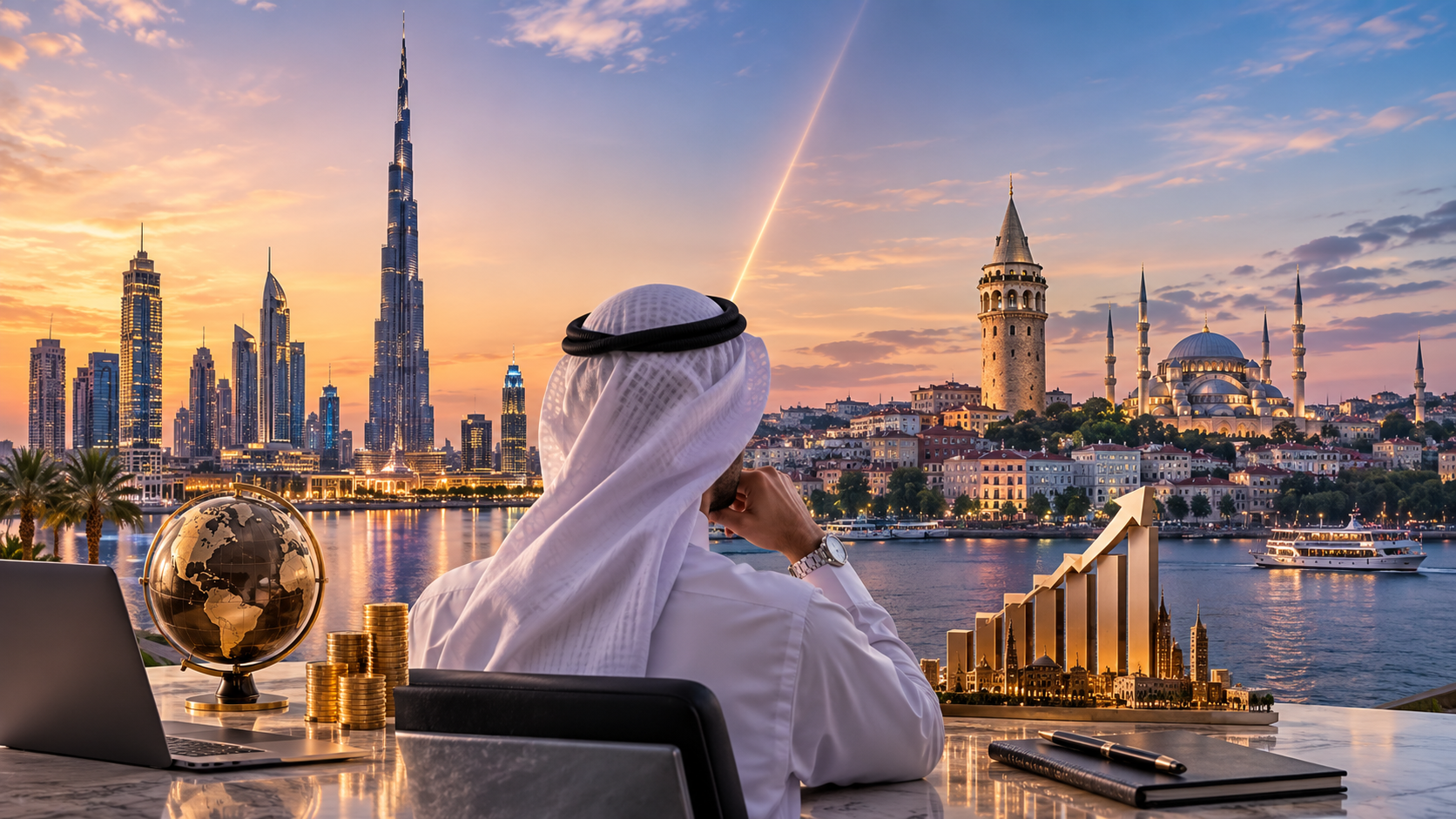
Dubai and Istanbul remain two of the most attractive real estate destinations for Gulf investors in 2026. Both cities offer residential, commercial and investment opportunities, but they differ considerably in property pricing, currency exposure, rental markets, ownership regulations, taxes, residency options and long-term growth prospects.
Dubai has established itself as a global business, tourism and investment hub. It offers an internationally connected real estate market, modern infrastructure, a wide range of residential developments, a currency pegged to the US dollar and a well-developed property-management industry.
Istanbul, on the other hand, provides access to a large metropolitan housing market, diverse property options, comparatively different entry-price levels across many districts, urban development opportunities and potential investment-related residency or citizenship pathways under Turkish law.
For Gulf investors, the decision is not simply about choosing the city with the highest advertised rental yield. It is about identifying the market that best fits their capital, financial objectives, risk tolerance, preferred currency, investment horizon and exit strategy.
A Gulf investor seeking rental income in a currency linked to the US dollar may prefer Dubai. An investor seeking geographical diversification, different price-entry options or a long-term investment in Türkiye may consider Istanbul.
This comprehensive guide compares Dubai and Istanbul property investment in 2026, covering market conditions, property prices, rental yields, currency risk, taxation, ownership rules, residency, investment districts, property types and practical investment strategies.
Why Gulf Investors Consider Dubai and Istanbul
Both cities offer advantages that attract investors from Saudi Arabia, Kuwait, Qatar, Bahrain, Oman and other Gulf countries.
Dubai: An International Investment Hub
Dubai has developed into one of the region's most internationally connected property markets, supported by business activity, tourism, infrastructure, global companies and a wide range of residential communities.
Key attractions for Gulf investors include:
- Geographic proximity to GCC countries.
- Frequent direct flights.
- The UAE dirham's peg to the US dollar.
- A large international property market.
- Freehold ownership in designated areas.
- Diverse residential and commercial property options.
- Established long-term and short-term rental markets.
- Modern transport and urban infrastructure.
- Property-linked residency opportunities subject to eligibility.
- Access to professional property-management services.
Dubai's international reputation also helps attract foreign residents, business professionals, entrepreneurs and tenants from different nationalities.
Istanbul: A Large Metropolitan Market with Diverse Opportunities
Istanbul is Türkiye's largest city and a major economic, cultural and commercial centre. Its property market is supported by local housing demand, international buyers, residential development, infrastructure projects and the city's strategic location between Europe and Asia.
Key attractions include:
- Diverse property options across different budgets.
- Access to a large local housing market.
- Modern residential developments.
- Apartments, villas, commercial properties and offices.
- Potential long-term opportunities in developing districts.
- Rental demand from residents, professionals, students and families.
- Potential property-based residence eligibility under applicable regulations.
- A qualifying Turkish citizenship-by-investment pathway.
- Opportunities to diversify an international property portfolio.
However, Istanbul investment requires careful consideration of inflation, currency movements, construction quality, legal requirements, property-management costs and district-level supply and demand.
Dubai vs Istanbul: General Market Comparison
|
Investment Factor |
Dubai |
Istanbul |
|---|---|---|
|
Market profile |
Global, internationally connected |
Large domestic and international market |
|
Currency |
AED pegged to USD |
Turkish lira |
|
Property prices |
High in many prime areas |
Wide range of entry prices |
|
Property selection |
Luxury, mid-market and affordable |
Diverse residential and commercial options |
|
Rental market |
Strong in many communities |
Large local rental market |
|
Currency stability for USD-based investors |
Relatively predictable |
Subject to currency fluctuations |
|
Personal income tax locally |
No UAE personal income tax |
Turkish tax may apply |
|
Foreign ownership |
Freehold in designated areas |
Subject to nationality and legal restrictions |
|
Property-linked residency |
Available for qualifying investors |
Potential residence eligibility subject to conditions |
|
Citizenship by property |
No automatic citizenship route |
Qualifying investment route subject to requirements |
|
Property management |
Extensive professional ecosystem |
Local managers and agencies available |
|
Liquidity |
Active market, varies by location |
Varies by district and property type |
|
Main risks |
Supply, prices, service fees and market cycles |
Inflation, currency, legal and regional risks |
|
Best suited for |
USD-linked income and global investment |
Diversification and longer-term opportunities |
Property Prices: Where Can Investors Buy at a Lower Entry Cost?

Purchase price is one of the most important factors for Gulf investors comparing the two cities.
Property Prices in Dubai
Dubai's property prices vary considerably depending on location, building quality, project age, amenities, proximity to transport, waterfront access and market positioning.
Popular investment locations include:
- Dubai Marina.
- Downtown Dubai.
- Business Bay.
- Jumeirah.
- Palm Jumeirah.
- Dubai Hills Estate.
- Jumeirah Village Circle.
- Dubai South.
- Dubai Production City.
- Dubai Investments Park.
Prime and luxury districts offer access to premium tenants and international buyers, but their purchase prices may be considerably higher.
Mid-market and affordable communities can be more attractive to investors focusing on rental yield, particularly where purchase prices are lower and tenant demand remains broad.
A more expensive property does not necessarily generate a higher rental yield. Luxury properties may have higher absolute rents but lower rent-to-purchase-price ratios than smaller apartments in affordable communities.
Property Prices in Istanbul
Istanbul offers considerable price variation across districts and property types.
Districts investors may research include:
- Başakşehir.
- Beylikdüzü.
- Bahçeşehir.
- Küçükçekmece.
- Halkalı.
- Kağıthane.
- Şişli.
- Kadıköy.
- Maltepe.
- Kartal.
- Pendik.
- Arnavutköy.
Depending on the district and development, investors may find apartments with lower entry prices than many Dubai investment areas. The city also offers premium residences, waterfront apartments, luxury developments and family-oriented communities.
Modern residential projects with amenities may appeal to investors who want to purchase a property that can attract tenants, particularly if it is close to transport, schools, hospitals, shopping centres or employment areas.
However, the lowest-priced property is not necessarily the best investment. Location, construction quality, accessibility, rental demand, management fees and resale prospects should be assessed together.
Rental Yields: Which City Offers Better Income Potential?
Rental yield is one of the most commonly used indicators when comparing property investment in Dubai and Istanbul.
Investors should distinguish between gross and net rental yield.
Gross Rental Yield
The gross rental yield is calculated by dividing annual rental income by the property's purchase price.
Gross yield = Annual rent ÷ Property purchase price × 100
For example, if an investor purchases a property for USD 200,000 and earns USD 14,000 annually in rent:
Gross rental yield = 7%.
Net Rental Yield
Net yield accounts for expenses, including:
- Property management.
- Maintenance.
- Service charges.
- Insurance.
- Vacancy periods.
- Taxes.
- Leasing and marketing costs.
- Furnishing and equipment.
- Financing expenses.
Net yield is a more useful indicator of the property's actual investment performance.
Rental Market in Dubai
Dubai has an active rental market supported by expatriates, business professionals, families, international companies and tourism.
Market reports in 2026 indicated differences in yields across property types and communities. Some affordable and mid-market areas recorded higher gross yields than selected luxury locations.
For example, 2026 reports indicated residential rental yields around the 6% range in certain market averages, while some affordable districts recorded higher yields and prime luxury areas generally showed lower percentage yields. Actual results vary by community and individual property.
Rental Market in Istanbul
Istanbul benefits from a large tenant base, including local residents, families, employees, students and foreign residents.
Rental income, however, is commonly linked to the Turkish lira, making currency analysis essential for international investors.
A property may generate rising nominal rental income in TRY, but the investor's return in USD, AED, SAR or another currency may differ substantially because of exchange-rate movements.
Some districts have strong rental demand, while others may face increasing competition from newly completed residential projects.
Market comparisons published in November 2026 showed that gross yield indicators in Dubai and Istanbul can be relatively close in certain comparisons, although purchase prices and rents differ substantially. Therefore, the average yield alone should not determine the investment decision.
Rental Yield, Costs and Investment Opportunities: Comparison Table|
Factor |
Dubai |
Istanbul |
|---|---|---|
|
Entry price |
Higher in many prime areas |
Wide range of prices |
|
Rental income currency |
AED |
Usually TRY |
|
USD-linked currency |
Yes |
No |
|
Tenant base |
Professionals, companies, tourists, residents |
Families, employees, students and residents |
|
Property management |
Established professional services |
Local agencies and management companies |
|
Acquisition costs |
Registration and related fees |
Title transfer, taxes and related costs |
|
Maintenance |
Depends on building and community |
Depends on project and building |
|
Luxury property |
Extensive selection |
Available in central and waterfront areas |
|
Affordable property |
Available in several districts |
Broad selection |
|
Off-plan market |
Large development sector |
Diverse new developments |
|
Currency risk |
Lower for USD-based investors |
Higher due to TRY movements |
|
Growth opportunities |
Location, demand and supply dependent |
District development, demand and macroeconomic conditions |
|
Long-term holding |
Suitable for many investment strategies |
Potentially suitable for investors who accept currency risk |
|
Residency investment |
Eligible property may support residency |
Property ownership may support eligibility subject to conditions |
|
Citizenship investment |
No automatic property citizenship program |
Qualifying investment route under applicable requirements |
Currency: A Critical Difference for Gulf Investors
Currency is one of the most important distinctions between the Dubai and Istanbul property markets.
The UAE Dirham and Dollar Stability
The UAE dirham is pegged to the US dollar, giving investors who hold USD or currencies linked to it greater predictability in currency planning.
When a Gulf investor purchases property in Dubai and receives rental income in AED, converting that income into USD or other dollar-linked currencies is relatively predictable from an exchange-rate perspective.
This may appeal to investors who:
- Want rental income in a USD-linked currency.
- Seek to preserve capital in a strong currency.
- Have financial obligations denominated in USD.
- Prefer lower foreign-exchange volatility.
- Plan to sell their property after several years.
Currency stability does not eliminate property-market risks, but it can reduce one important source of uncertainty.
The Turkish Lira and Foreign Exchange Risk
In Istanbul, many properties and rental contracts are priced or paid in Turkish lira, although some developments are marketed in USD or EUR.
Investors should analyse three variables:
1. The property's purchase price.
2. Rental income in Turkish lira.
3. The exchange rate when rental income or capital is converted into the investor's home currency.
Property prices and rents may rise in nominal TRY terms without generating equivalent growth in USD or Gulf currencies.
For example, a property may increase in local-currency value, but if the lira weakens against the dollar, the investor's foreign-currency capital appreciation may be lower.
Istanbul may therefore suit investors who:
- Can hold property for several years.
- Accept foreign-exchange risk.
- Do not need to convert rental income immediately.
- Focus on long-term district development.
- Purchase at a carefully evaluated price rather than relying on speculative forecasts.
Taxes and Acquisition Costs: Dubai vs Istanbul
Taxes and transaction expenses have a direct impact on net returns.
Dubai Property Costs
Investors should consider:
- Dubai Land Department registration fees.
- Title deed issuance fees.
- Registration trustee fees.
- Broker commissions where applicable.
- Developer-related charges.
- Annual service charges.
- Maintenance expenses.
- Property-management fees.
- Mortgage and financing expenses.
Dubai's property transfer registration fee is generally 4%, although investors should verify the applicable allocation between buyer and seller and any additional charges.
The UAE does not impose personal income tax on individuals, but investors should also consider their tax residency and obligations in their home countries or other jurisdictions.
Istanbul Property Costs
In Türkiye, property buyers may face:
- Title deed transfer fees.
- Property transfer tax.
- Valuation costs where applicable.
- Translation and notarisation.
- Legal fees.
- Required insurance.
- Utility connection costs.
- Building or community dues.
- Maintenance expenses.
- Rental income tax.
- Potential costs upon resale.
The actual expenses depend on the property, transaction structure, current rules and whether the property is ready or under construction.
Why Total Acquisition Cost Matters
A property may appear attractive based on its purchase price and annual rent, but its net return may be lower after registration, maintenance, management, taxes, vacancy and financing expenses.
Investors should calculate:
Total investment cost = Purchase price + acquisition fees + furnishing + financing + operating expenses.
The expected rental income should be compared with the full cost rather than the advertised property price.
Residency and Citizenship: Can Property Ownership Provide a Legal Status?

Residency is a major consideration for many Gulf investors comparing Dubai and Istanbul.
However, residency, investment residency and citizenship are different legal categories and should not be confused.
Property-Linked Residency in Dubai
Certain property investments may qualify investors for long-term residency in Dubai, subject to the relevant programme requirements, property value, ownership conditions, documentation and government approval.
One recognised route involves eligible property ownership of AED 2 million or more for potential five-year Golden Visa eligibility, subject to the applicable rules.
Property purchase alone does not automatically guarantee residency. Investors should confirm eligibility before completing the transaction.
Property Residency in Istanbul
Property ownership may support eligibility for a Turkish short-term residence permit under the applicable laws and regulations.
However, buying any property does not automatically guarantee residence. Eligibility may depend on:
- Property value.
- Location.
- Title deed status.
- Applicant nationality.
- Restrictions on foreign residence in certain areas.
- Current legal and administrative requirements.
Investors should verify the property and applicant eligibility before paying a deposit or signing a purchase contract.
Turkish Citizenship by Investment
Türkiye offers a citizenship-by-investment route through qualifying real estate investment.
The commonly applicable minimum property investment amount is USD 400,000, subject to the programme's requirements, including the required restriction on selling the property for three years and completion of the official process.
This may be attractive to investors who seek property ownership alongside a potential citizenship pathway, but it should not be the sole basis of a purchase without independent legal and financial analysis.
Best Areas for Property Investment in Dubai in 2026
Dubai's investment districts differ in pricing, rental demand, tenant profiles and investment characteristics.
Dubai Marina
Dubai Marina is a well-known international residential destination featuring high-rise apartments, restaurants, leisure facilities and waterfront living.
It may appeal to investors targeting:
- International tenants.
- Professionals.
- Expatriates.
- Rental apartments.
- Buyers seeking a globally recognised district.
However, premium property prices may reduce percentage rental yields compared with more affordable areas.
Business Bay
Business Bay offers proximity to Downtown Dubai, commercial activity, offices, restaurants and residential developments.
It may appeal to investors targeting professionals and tenants who want access to central business districts.
Jumeirah Village Circle (JVC)
JVC is often considered by investors looking for mid-market apartments, residential communities and rental demand.
It may suit investors focusing on rental yield, but they should compare competing developments, service charges, building quality and the number of newly delivered units.
Dubai South
Dubai South is linked to aviation, logistics and urban development. It may attract investors looking for long-term growth opportunities.
However, investors should assess the timing of development, actual tenant demand, project delivery and local market conditions rather than relying exclusively on future growth forecasts.
Dubai Hills Estate
Dubai Hills Estate features modern residential communities, green spaces, shopping facilities and family-oriented amenities.
It may appeal to investors interested in apartments, villas and townhouses in established master-planned communities.
Best Areas for Property Investment in Istanbul in 2026
Istanbul offers a wide range of districts, including central locations, modern suburbs, waterfront communities and emerging development areas.
Başakşehir
Başakşehir attracts buyers looking for modern residential projects, family-oriented communities, healthcare facilities, shopping areas and infrastructure.
Key attractions include:
- Modern developments.
- Healthcare facilities.
- Schools.
- Shopping centres.
- Family communities.
- Transport and road infrastructure.
- Urban development opportunities.
It may suit investors interested in modern residential properties and long-term rental demand from families.
Beylikdüzü
Beylikdüzü offers a broad selection of residential projects, green areas, modern facilities and different apartment types.
It may be suitable for investors looking for relatively accessible entry prices compared with certain central districts, but they should consider transport, employment access and competing supply.
Bahçeşehir
Bahçeşehir is known for residential communities, modern developments and family-oriented living.
It may appeal to investors planning to hold property for several years or rent to families seeking larger apartments and community amenities.
Küçükçekmece and Halkalı
These districts are important to investors interested in urban development and transport infrastructure.
They offer diverse residential projects and potential opportunities associated with future accessibility and development.
Investors should assess the property's actual proximity to transport, current rental demand, development stage and project quality.
Kadıköy, Maltepe and Kartal
These Asian-side districts offer a range of residential, commercial and urban opportunities.
- Kadıköy: A major central district with commercial, cultural and residential activity.
- Maltepe: A coastal district with various residential developments.
- Kartal: A developing urban area offering different property options.
- Pendik: A district with transport connections, services and residential projects.
These areas may suit long-term investors, but property performance varies substantially by neighbourhood, building and project.
Ready Properties vs Off-Plan Developments
Ready properties and off-plan developments offer different investment advantages and risks in both markets.
Ready Properties
Ready properties may suit investors who want to:
- Take possession immediately.
- Start renting sooner.
- Inspect the building and facilities.
- Assess the property's condition.
- Compare actual rental listings.
- Reduce delivery-related uncertainty.
In Dubai, completed properties may be attractive to investors seeking immediate rental income in established communities.
In Istanbul, ready properties allow buyers to assess the residential complex, location, facilities, construction condition and rental demand before purchasing.
Off-Plan Properties
Off-plan developments may provide:
- Lower initial payments.
- Developer payment plans.
- Modern designs and facilities.
- Access to new developments.
- Opportunities to select units before completion.
- Potential price differences between launch and completion.
However, they also involve risks, including:
- Construction delays.
- Developer risk.
- Changes in market conditions.
- Future competition from new supply.
- Changes in expected rental demand.
- Uncertain resale value.
- Contractual and delivery risks.
Off-plan properties remain a major component of Dubai's market, but buyers have become more selective about developer reputation, location, pricing and long-term investment potential.
Engel & Völkers+1
In Istanbul, buyers should carefully verify construction licences, the developer's track record, construction progress, contract terms, legal guarantees and title-deed arrangements.
Liquidity and Resale Potential
Liquidity matters to investors who may need to sell their property within a specific timeframe.
Dubai
Dubai has an active international real estate market with a large number of buyers, brokers, developers and marketing platforms.
However, liquidity varies significantly between communities and properties.
A property in a highly demanded area may be easier to sell than a similar unit in a project with substantial competing supply.
Resale performance depends on:
- Asking price.
- Location.
- Building condition.
- Service charges.
- Market supply.
- Property quality.
- Rental demand.
- Market conditions at the time of sale.
Istanbul
Istanbul has a large property market, but resale liquidity differs between districts and property types.
Properties in central locations or areas with established housing demand may attract buyers more readily than developments in areas with substantial new supply or weaker demand.
Investors should consider the local Turkish buyer market as well as foreign buyers.
A property appealing to local families and residents may have a broader potential buyer base than a property targeting only a limited international segment.
Investment Risks in Dubai and Istanbul
No real estate investment is risk-free.
Main Risks in Dubai
1. Increasing supply in certain districts.
2. Property-price corrections.
3. High service charges in some developments.
4. Differences in developer quality.
5. Competition between ready and newly launched properties.
6. Changing rental demand.
7. Acquisition expenses.
8. Overpaying for a property.
9. Reliance on speculative price appreciation.
10. Purchasing a unit that does not match the target tenant profile.
Main Risks in Istanbul
1. Turkish lira fluctuations.
2. Inflation and maintenance-cost increases.
3. Changes in laws and regulations.
4. Construction-quality differences.
5. Earthquake risk and structural-safety considerations.
6. District-level rental demand variations.
7. Remote property management.
8. Residence-eligibility restrictions.
9. Construction delays.
10. Foreign-currency return uncertainty.
How Investors Can Reduce Risk
Conduct independent legal due diligence.
- Verify title deeds.
- Compare similar properties.
- Check service charges.
- Inspect construction quality.
- Confirm licences and permits.
- Calculate net rental yield.
- Analyse currency risk.
- Avoid relying solely on broker promises.
- Establish a realistic exit strategy before purchasing.
Dubai or Istanbul in 2026?
Dubai and Istanbul are both important property markets for Gulf investors, but they offer different investment profiles.
Dubai May Be Better for Investors Who:
- Prefer a currency linked to the US dollar.
- Seek an international real estate market.
- Want convenient property oversight.
- Are interested in eligible long-term residency programmes.
- Seek rental income in an active market.
- Prefer modern communities and established infrastructure.
- Want to reduce currency exposure compared with the Turkish lira.
Istanbul May Be Better for Investors Who:
- Want to diversify their real estate portfolio.
- Seek a broad range of property options.
- Can accept foreign-exchange risk.
- Have a long-term investment horizon.
- Want exposure to a large domestic housing market.
- Are interested in residence or citizenship eligibility under applicable rules.
- Seek different property-entry price levels.
Investors with larger capital may consider allocating funds across both cities to diversify geographically and financially rather than relying on a single market.
Ultimately, a successful investment should not be based solely on a city's reputation, marketing campaigns or promised returns. The most important factors are the specific property's price, location, real rental demand, full ownership costs, legal status, risks and exit strategy.

We, at Damas Group Real Estate, bring you the best property options for sale in Ankara, Turkey in 2023. We're here to help you seize the best investment opportunities in major construction projects and residential complexes at competitive prices.
Our services include providing all kinds of legal and real estate consultations, obtaining property deeds, and assisting you in acquiring Turkish property residency and citizenship, along with other post-sale services.
Feel free to reach out to us to learn more!
FAQ
There is no universal answer. Dubai may suit investors seeking an internationally connected market, a dollar-linked currency and an established investment environment. Istanbul may suit investors seeking geographical diversification, different property-price options and long-term opportunities. The choice depends on budget, objectives and risk tolerance.
Both markets offer rental opportunities, but yields vary by district, property type and purchase price. Some affordable Dubai communities may offer relatively high gross yields, while selected Istanbul districts may also provide attractive rental opportunities. Net yield should always be calculated after expenses.
Currency movements are a major consideration for international investors. Property values and rents may rise in TRY terms, but the return when converted into USD or Gulf currencies may be affected. Investors should evaluate foreign-currency returns rather than relying only on local-currency figures.
Certain qualifying property investments in Dubai may support long-term residency eligibility. Türkiye has property-related residence options and a qualifying citizenship-by-investment pathway, subject to the applicable legal requirements. Property ownership alone does not guarantee residency or citizenship.
If the investor has sufficient capital, diversification across both markets may be worth considering, provided each property is individually analysed. With a limited budget, it may be preferable to focus on one well-selected property with good quality, location and realistic rental potential rather than buying multiple properties without proper due diligence.