Table of Contents
When Transportation Infrastructure Becomes a Real Estate Driver
Istanbul’s real estate market is no longer shaped only by proximity to the historic city center, sea views, luxury amenities or the quality of a residential project.
As the city continues to expand, transportation connectivity has become one of the most important factors influencing residential demand, rental potential and long-term investment attractiveness.
This is one of the main reasons why Arnavutköy and Halkalı have gained increasing attention from real estate investors.
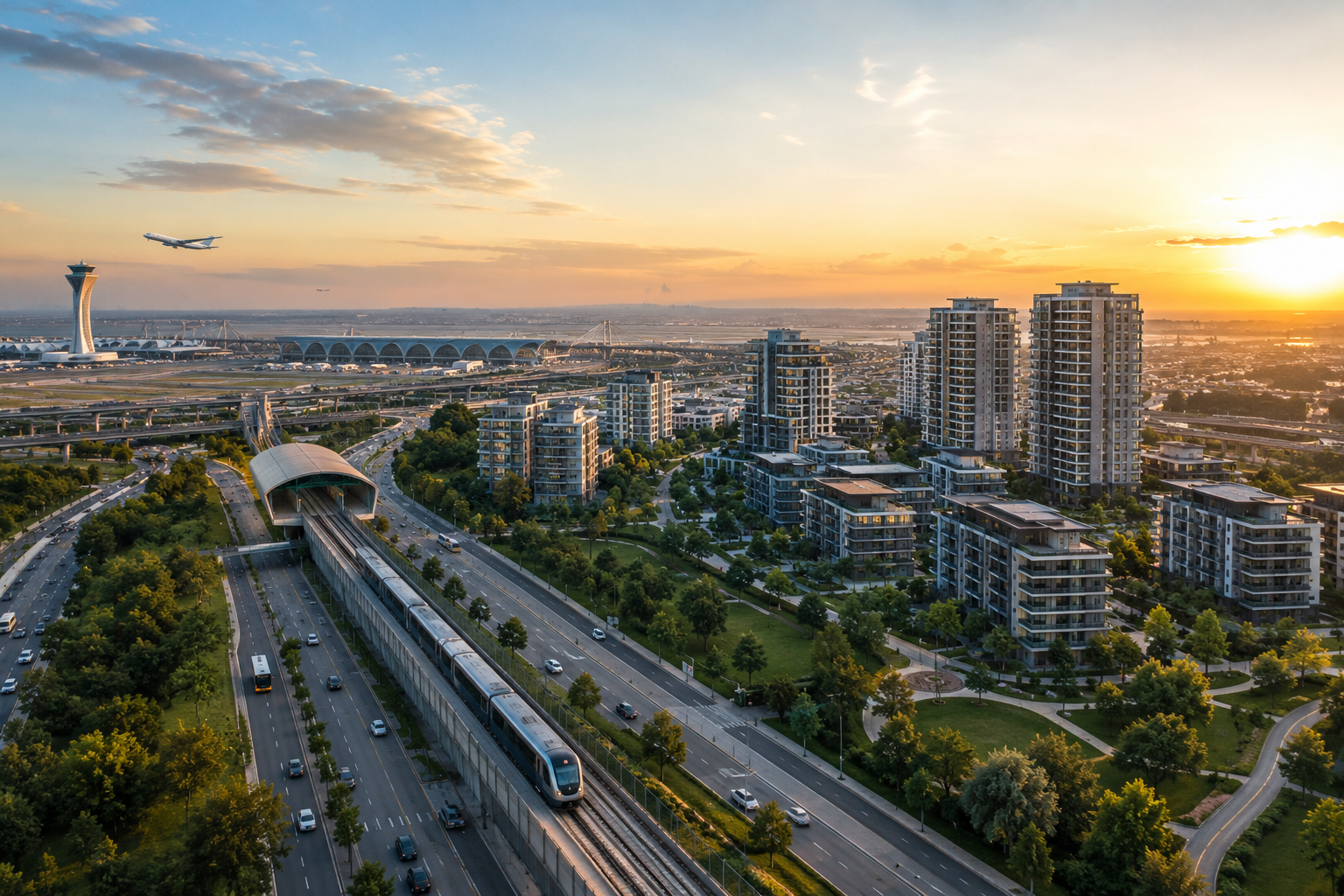
The most important recent development came in June 2026, when the Halkalı–Arnavutköy section of the Istanbul Airport–Halkalı metro corridor was officially opened. The new section strengthened the railway connection between Halkalı, Arnavutköy and Istanbul Airport and connected the corridor with several other metro systems.
For investors, this is significant because the transportation improvement is no longer merely a future proposal. A major part of the infrastructure is now operational.
However, investors should avoid a simplistic assumption that a new metro line automatically guarantees property price increases.
Transportation improves accessibility; accessibility can improve demand; but the performance of an individual property still depends on many other factors.
Why Does Transportation Matter So Much for Real Estate?
Transportation changes the practical meaning of distance.
A property may be geographically far from Istanbul’s central business districts but still be attractive if residents can reach important destinations quickly and conveniently.
Conversely, a property that appears geographically close to the city center may be less attractive if transportation is inefficient.
This is why metro stations, Marmaray connections, major highways and airport access have become increasingly important in Istanbul’s property market.
The new Halkalı–Arnavutköy metro section is particularly important because it is integrated into a wider transportation network rather than functioning as an isolated line.
According to Turkey’s Ministry of Transport and Infrastructure, the line provides a connection between Halkalı and Istanbul Airport in approximately 30 minutes under the announced operating plan, while Halkalı station integrates with Marmaray.
Halkalı: From Residential District to Transportation Hub
Halkalı has been undergoing a major transformation.
Historically, it was known as an important residential area on Istanbul’s European side. However, its strategic importance has increased as several transportation systems have converged in the area.
The completion of the Halkalı–Arnavutköy metro section significantly strengthened this position.
The approximately 22-kilometer section includes stations such as:
İbn Haldun University
Kayaşehir
Olimpiyatköy
Halkalı Stadium
Halkalı
The wider metro corridor is part of a 69-kilometer network connecting Halkalı with Istanbul Airport and other major parts of Istanbul.
Halkalı and Marmaray Integration
One of Halkalı’s strongest investment advantages is its connection to Marmaray.
This means residents are not limited to a single metro corridor.
They can potentially access a much wider transportation network connecting different parts of Istanbul.
For real estate investors, this matters because tenants and owner-occupiers generally value time savings.
A property that provides convenient access to several employment centers, universities, shopping districts and transportation hubs may have a wider potential tenant base than a similar property dependent mainly on private vehicles.

Halkalı and the Halkalı–Kapıkule Railway Project
Halkalı’s strategic importance also extends beyond Istanbul’s urban transportation network.
The Halkalı–Kapıkule railway project is designed to strengthen Turkey’s connection with Europe through a modern passenger and freight railway corridor.
The project covers approximately 229–231 kilometers and is planned as a high-speed, double-track railway capable of passenger and freight transportation.
In 2026, the project recorded further operational developments, including freight-train testing and operation on sections of the corridor.
For Halkalı, this adds another layer of strategic importance.
The district is therefore becoming not simply a residential location but a potential multimodal transportation node.
Why Is Halkalı Attractive to Property Investors?
Halkalı’s investment story can be summarized through five major factors:
Multiple transportation options
Residents can benefit from an expanding railway network rather than relying on a single transportation method.
Istanbul Airport connectivity
The new metro corridor makes airport access one of Halkalı’s major advantages.
Marmaray integration
This significantly expands the practical reach of the district.
Established residential demand
Halkalı already has a substantial residential base and a large number of modern housing developments.
Continued urban development
Infrastructure improvements can attract additional commercial services, residential development and economic activity.
Nevertheless, not every property in Halkalı is automatically a good investment.
Investors should examine the exact location, distance to stations, title deed, legal status, construction quality, maintenance costs, rental market and resale liquidity.
Arnavutköy: A Strategic New Growth Area
Arnavutköy has a different investment profile.
Its biggest advantage is its relationship with Istanbul Airport.
The airport has transformed the economic geography of Istanbul’s northern and northwestern areas.
Arnavutköy, once viewed primarily as a peripheral district with long-term development potential, has gained greater strategic relevance as transportation infrastructure has expanded.
The new metro connection strengthens this transformation.
The New Metro Changes Arnavutköy’s Investment Equation
Before the completion of the Halkalı–Arnavutköy connection, transportation between these areas relied more heavily on roads and bus networks.
With the new metro connection, Arnavutköy has become part of a wider railway corridor connecting it with Halkalı and Istanbul Airport.
This creates a combination of:
airport access + metro connectivity + road infrastructure + residential development + economic activity + logistics potential.
That combination explains why many investors are paying greater attention to the district.
Istanbul Airport and Its Potential Real Estate Impact
A major international airport creates demand far beyond passengers.
It supports employment in:
Aviation
Ground services
Security
Hospitality
Restaurants
Logistics
Cargo
Maintenance
Transportation
Commercial services
This creates a potential pool of workers and professionals who require housing.
As economic activity expands around an airport, additional demand can emerge for:
Housing
Hotels
Offices
Retail
Warehouses
Restaurants
Service businesses
However, investors should not assume that proximity to the airport alone guarantees high rental yields.

Why Could Arnavutköy Be Attractive for Long-Term Investors?
Unlike Istanbul’s mature central districts, parts of Arnavutköy still have room for urban expansion and new development.
This creates a different investment proposition.
A mature central district may offer:
Higher entry prices
More established demand
Greater liquidity
Less room for physical expansion
A developing district may offer:
More competitive entry prices in selected locations
New residential projects
Infrastructure-driven growth potential
Greater long-term upside potential
But it may also involve:
Higher development risk
Greater competition between projects
Lower liquidity in some locations
Longer investment horizons
Therefore, Arnavutköy may be particularly interesting for investors who can think in medium- to long-term timeframes.
Halkalı vs. Arnavutköy
|
Investment Factor |
Halkalı |
Arnavutköy |
|
Public transportation |
Very strong |
Increasing rapidly |
|
Istanbul Airport access |
Very strong |
Excellent |
|
Marmaray |
Major advantage |
Limited direct relevance |
|
Urban maturity |
Relatively mature |
Developing in many areas |
|
Residential supply |
Extensive |
Expanding |
|
Long-term potential |
High |
Very high in selected areas |
|
Rental demand |
Broad residential base |
Growing with development |
|
Main investment story |
Connectivity |
Airport + growth |
|
Risk profile |
Project-dependent |
More location-dependent |
|
Ideal investor profile |
Income + long-term |
Long-term growth |
This is an analytical comparison rather than a guaranteed investment ranking.
Does a New Metro Automatically Increase Property Prices?
No.
This is one of the most important points for foreign investors.
A metro line can:
Improve accessibility.
Reduce commuting time.
Increase tenant interest.
Attract new commercial activity.
Improve the perception of a neighborhood.
Encourage developers to launch new projects.
But property prices are also influenced by:
Interest rates
Inflation
Construction costs
Supply and demand
Currency movements
Local employment
Project quality
Legal conditions
Rental yields
Market liquidity
Therefore:
Metro connectivity should be treated as one major investment factor, not as a guarantee of appreciation.
Why the Exact Distance from the Metro Matters
It is not enough to say:
“This property is in Halkalı.”
Or:
“This project is in Arnavutköy.”
Large districts can contain very different micro-markets.
Investors should examine:
Walking distance to the station
Actual walking time
Road accessibility
Bus connections
Schools
Hospitals
Shopping centers
Universities
Commercial areas
Future urban plans
Density of new projects
A property located within a practical walking distance of a major station may have a different rental and resale profile from another property carrying the same district name but located several kilometers away.
Transportation and Rental Demand
Transportation can be particularly important for rental properties.
Tenants often ask:
“How long will it take me to reach work?”
This is frequently more important than the theoretical geographical distance.
Halkalı could benefit from its integrated railway connections, while Arnavutköy could benefit from demand associated with the airport and surrounding economic activities.
However, rental returns must always be calculated using actual local rents and operating expenses, rather than marketing estimates.
Resale Potential
Some investors purchase property with the intention of holding it for several years and selling it after the area matures.
For this strategy, investors should look for:
Infrastructure investment
Population growth
New services
Commercial development
Real housing demand
Reputable developers
Reasonable acquisition prices
Good resale liquidity
This is where both Halkalı and Arnavutköy become interesting.
But the key word is potential.
No district can guarantee a specific percentage of capital appreciation.
The New Metro and Istanbul’s Changing Urban Geography
The importance of the Halkalı–Arnavutköy project goes beyond the two districts.
The line connects with several existing metro systems, including connections around Kayaşehir, Olimpiyatköy and Halkalı Stadium, while Halkalı provides integration with Marmaray.
This means that the investment impact should be evaluated at the network level.
A transportation line becomes significantly more valuable when passengers can transfer to other lines and reach multiple destinations without depending on private cars.
Early Investment vs. Mature Investment
There is a common belief that buying before infrastructure is completed is always better.
That is not necessarily true.
Early-stage investments can offer attractive entry opportunities, but they may also involve:
Construction delays
Infrastructure delays
Limited services
Lower rental liquidity
Oversupply
Developer risk
Changes in urban planning
The best strategy is not necessarily to buy as early as possible.
It is to buy when the risk-return relationship is attractive.
What Should Investors Look for in Halkalı?
Investors considering Halkalı should prioritize:
Transportation proximity
Study the actual route to metro and Marmaray stations.
Project quality
A strong location cannot compensate for poor construction quality.
Rental demand
Check real rental listings and comparable properties.
Maintenance fees
High service charges can reduce the net rental return.
Legal status
Verify the title deed, liens, restrictions, permits and ownership status.
Exit strategy
Before buying, determine who the likely buyer will be when you eventually sell.
What Should Investors Look for in Arnavutköy?
Arnavutköy requires particularly careful micro-location analysis.
Investors should examine:
Distance to Istanbul Airport
Distance to metro stations
Road accessibility
Existing services
New infrastructure
Residential development
Commercial growth
Local rental demand
Future urban planning
Resale liquidity
Being “near Istanbul Airport” is not enough.
A successful investment depends on the complete location profile.
Transportation Usage as an Indicator
The new railway connection has already demonstrated substantial passenger usage.
The Ministry of Transport reported that the Halkalı–Arnavutköy section served more than 10,000 passengers on its first operating day, while the full Gayrettepe–Istanbul Airport–Halkalı corridor served more than 44,000 passengers that day.
A few days later, the ministry reported that the corridor reached more than 53,000 passengers in a single day.
These figures demonstrate the importance of the transportation corridor.
However, they should not be interpreted as a direct forecast of property price appreciation.
Passenger demand and real estate appreciation are related through multiple economic mechanisms, not through a simple one-to-one formula.
Which Is Better: Halkalı or Arnavutköy?
There is no universal answer.
Halkalı may be better suited to investors looking for:
Strong railway connectivity
Marmaray access
Established residential demand
Multiple transportation options
Easier access to different parts of Istanbul
Arnavutköy may be more attractive to investors seeking:
Istanbul Airport proximity
Long-term urban development
New residential projects
Potential growth associated with transportation infrastructure
Exposure to an expanding economic zone
In simple terms:
Halkalı represents connectivity and relative maturity.
Arnavutköy represents airport proximity, expansion and long-term development potential.
The Importance of the Halkalı–Kapıkule Railway
Halkalı’s strategic position could become even more significant as the Halkalı–Kapıkule railway project progresses.
According to Turkey’s Ministry of Transport and Infrastructure, the project is intended to reduce the journey between Halkalı and Kapıkule from approximately four hours to 1.5 hours once the relevant infrastructure is operational, while also substantially increasing passenger and freight capacity.
This gives Halkalı a broader role in Istanbul’s connection with Europe.
For real estate investors, this does not mean every property will benefit equally.
But it reinforces the district’s position as an important transportation node.
The Smart Way to Invest in These Areas
A disciplined investor should follow a structured process:
Step 1: Define the investment objective
Are you buying for:
Rental income?
Capital appreciation?
Residence?
Resale?
Long-term wealth preservation?
Step 2: Establish the complete budget
Include:
Purchase price
Taxes
Title deed costs
Legal fees
Furniture
Maintenance
Financing costs
Step 3: Analyze the micro-location
Do not stop at the district name.
Step 4: Compare comparable properties
Compare similar apartments in similar projects.
Step 5: Verify the developer
Check track record, delivery history and project documentation.
Step 6: Conduct legal due diligence
Verify the title deed and all legal restrictions.
Step 7: Define the exit strategy
Ask:
Who will buy this property from me in three or five years?
This question can be more useful than simply asking:
“How much will the price increase?”
Arnavutköy and Halkalı have become increasingly important on Istanbul’s real estate map because they sit at the intersection of several major infrastructure trends.
Halkalı is evolving into a major multimodal transportation hub supported by the new metro connection, Marmaray and the wider railway network toward Europe.
Arnavutköy benefits from Istanbul Airport, expanding metro connectivity, new residential development and the broader economic transformation of northwestern Istanbul.
The opening of the Halkalı–Arnavutköy metro section in June 2026 was a major milestone because it transformed an important planned connection into an operational transportation link.
For investors, however, the most important lesson is simple:
Do not invest in a district simply because a metro line has opened. Invest in a property whose location, price, legal status, construction quality, rental demand and resale potential make sense.
The strongest investment opportunity is created when several factors come together:
excellent accessibility + strong infrastructure + real housing demand + reasonable acquisition price + quality development + legal security + a clear exit strategy.
When these elements align, Halkalı and Arnavutköy can become compelling components of a long-term Istanbul real estate investment strategy.
FAQ
Arnavutköy has significant long-term development potential because of Istanbul Airport, expanding transportation infrastructure and urban growth. However, investors should analyze the exact project and micro-location rather than relying only on the district name.
Yes. The Halkalı–Arnavutköy section officially opened in June 2026 and became operational shortly afterward, strengthening the railway connection between Halkalı, Arnavutköy and Istanbul Airport.
Not necessarily. Halkalı has stronger multimodal transportation and Marmaray connectivity, while Arnavutköy benefits particularly from Istanbul Airport and long-term development potential. The best choice depends on the investor’s budget and strategy.