Table of Contents
Turkey continues to attract foreign buyers looking for residential properties, investment opportunities and long-term real estate ownership. However, foreign ownership of Turkish real estate is not completely unrestricted.
The right to purchase property depends on several factors, including the buyer's nationality, the location of the property, the total amount of property already owned by the buyer, the percentage of foreign ownership within the relevant district and the legal classification of the area.
This makes legal due diligence particularly important before paying a deposit or signing a final purchase agreement.
According to the official Invest in Türkiye investment guide, eligible foreign nationals can acquire real estate in Türkiye without having a Turkish residence permit as a prerequisite. However, their acquisition remains subject to the restrictions established under Turkish legislation.
The general legal framework also limits a foreign individual's acquisition of real estate and permanent independent rights in rem to 30 hectares nationwide, while total foreign ownership in a district cannot exceed 10% of the area subject to private ownership.
Therefore, the important question is not simply whether foreigners can buy property in Turkey, but also where they can buy, what restrictions apply and how the specific property should be checked before purchase.
Can Foreigners Buy Property in Turkey in 2026?
Yes, eligible foreign nationals can generally purchase real estate in Turkey, subject to the applicable legal restrictions.
Depending on the circumstances, foreign buyers can acquire apartments, villas, commercial properties, land and other types of real estate where private ownership is permitted.
However, eligibility differs according to nationality. Turkish legislation does not automatically give every foreign nationality identical property acquisition rights. The applicable countries and conditions are determined under the relevant legal framework.
One important advantage is that a Turkish residence permit is not generally required before purchasing real estate. A foreign buyer can therefore proceed with a property purchase without first obtaining a residence permit, provided that the buyer and property meet the legal requirements.
Main Restrictions on Foreign Property Ownership in Turkey
The restrictions can be divided into several categories:
Nationality restrictions.
Location-based restrictions.
Maximum ownership limits.
District-wide foreign ownership limits.
Military and military security zones.
Strategic areas.
Special security zones.
Additional restrictions applicable to certain land and protected areas.
Understanding these categories helps foreign buyers avoid confusing general property availability with actual eligibility for registration.
Nationality Restrictions
The first question a foreign buyer should ask is whether their nationality is eligible for property ownership in Turkey.
Under Article 35 of the Turkish Land Registry Law, foreign individuals who are citizens of countries designated under the applicable rules may acquire real estate, provided that legal restrictions are respected.
Consequently, buyers should verify their eligibility before paying a non-refundable deposit.
The fact that a property is openly advertised for sale does not automatically mean that every foreign buyer can register it in their name.
Are There Areas Where Foreigners Cannot Own Property?
Yes.
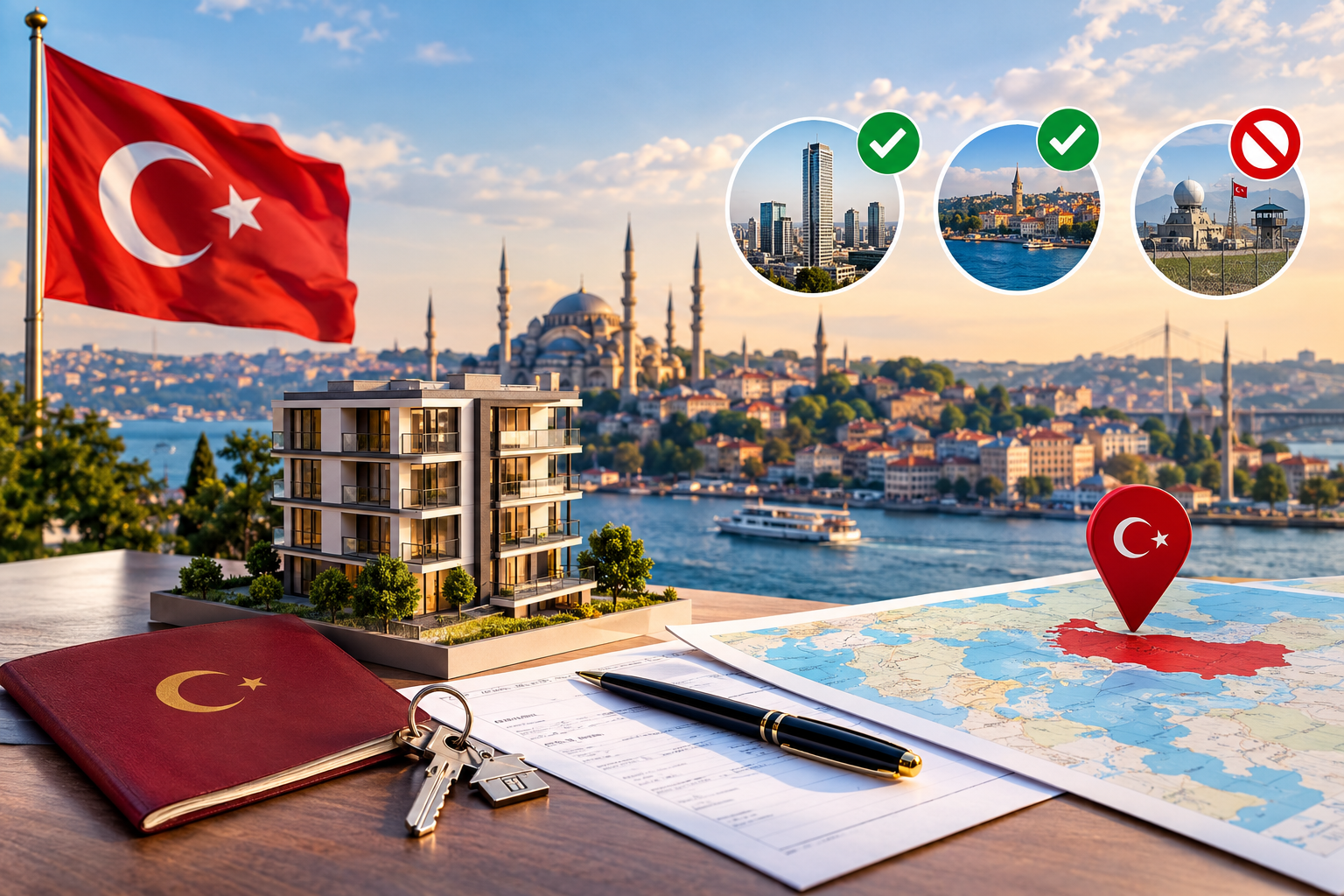
Foreign individuals cannot acquire or lease real estate in prohibited military zones and military security zones. Certain special security areas can also be subject to permission requirements.
However, it is important to understand that a restricted area does not necessarily mean that an entire province or city is closed to foreign ownership.
Restrictions can apply to specific areas, parcels or locations.
The official Your Key Türkiye platform explains that information concerning military restricted areas is incorporated into land registry records and used when foreign ownership applications are processed.
Military and Security Zones
Military areas are among the most important issues to investigate before purchasing property in Turkey.
A property may appear perfectly normal from a commercial perspective while still being subject to special restrictions because of its location.
For this reason, foreign buyers should verify:
The exact parcel.
The land registry status.
Whether the location is classified as a military restricted zone.
Whether it falls within a military security area.
Whether additional authorization is required.
The official framework distinguishes between prohibited military zones, military security zones and special security areas, meaning that the legal consequence can differ according to the exact classification.
Special Security Areas
Not every security-related classification automatically means an absolute prohibition.
According to the official investment guide, acquisition in certain special security areas may be possible subject to permission from the relevant governorate.
Therefore, buyers should not rely on general statements such as "security zone means impossible" or "the property is available because it is advertised."
The exact legal classification of the property must be established.
Strategic Areas
Turkey also has strategic areas in which foreign ownership can be subject to specific restrictions.
The official foreign property acquisition guidance recognizes strategic zones among the areas where special limitations may apply to foreign individuals and legal entities.
This is particularly relevant when considering:
Large plots of land.
Properties close to sensitive facilities.
Industrial or strategic locations.
Large-scale development projects.
The 30-Hectare Ownership Limit
One of the most important legal limits is the nationwide ownership ceiling.
As a general rule, a foreign individual may acquire real estate and permanent independent rights in rem up to 30 hectares throughout Turkey. The applicable legislation also provides legal authority to increase this amount in certain circumstances.
This restriction becomes particularly relevant for:
Agricultural land.
Development land.
Large plots.
Multiple land acquisitions.
Large-scale investment projects.
For an ordinary apartment buyer, this limit is unlikely to be the main practical issue, but it remains part of the legal framework.
The 10% District Limit
Another important restriction concerns the total amount of property owned by foreign nationals within a district.
Foreign ownership may not exceed 10% of the district area subject to private ownership.
This means that the legal availability of a specific property for a foreign buyer can depend not only on the property itself but also on the cumulative foreign ownership in the relevant district.
Consequently, an advertised property should not be considered automatically registrable simply because it has a valid title deed and is offered for sale.
Table 1: Main Foreign Property Ownership Restrictions in Turkey 2026
|
Restriction |
General Rule |
What It Means for the Buyer |
|
Nationality |
Buyer must be legally eligible |
Verify nationality before purchase |
|
Nationwide area |
Generally up to 30 hectares per person |
Especially relevant for land |
|
District foreign ownership |
Up to 10% of privately owned district area |
May affect registration |
|
Military prohibited zones |
Foreign ownership is not permitted |
Property location must be checked |
|
Military security zones |
Subject to restrictions |
Official verification required |
|
Special security zones |
Additional permission may apply |
Depends on the exact location |
|
Strategic areas |
May be subject to special restrictions |
Legal due diligence is essential |
|
Encumbrances |
Mortgages, liens and other restrictions may exist |
Title deed must be checked |
These restrictions are reflected in official Turkish guidance on foreign property acquisition.
Are Entire Turkish Cities Prohibited to Foreign Property Buyers?
This is an important point that is often misunderstood.
It is not accurate to rely on a permanent list stating that entire Turkish cities or provinces are simply "closed to foreigners" without checking the current legal status, the buyer's nationality and the specific property.
Military and security restrictions can relate to specific areas or parcels, and the relevant information is used by land registry offices when processing applications.
Therefore, instead of asking:
"Is this city open to foreigners?"
the more precise question is:
"Can this specific property be registered in the name of this foreign buyer?"
That distinction is particularly important in major markets such as Istanbul, Antalya, Bursa and Trabzon.
Buying Property in Istanbul as a Foreigner in 2026
Istanbul remains one of the most important markets for foreign residential and investment purchases.
Eligible foreign nationals can generally purchase property in Istanbul, but buyers still need to verify the individual property's legal status.
Before completing a transaction, it is advisable to check:
Buyer nationality.
Title deed status.
Property location.
Military/security restrictions.
Mortgages and liens.
Total foreign ownership limits.
District ownership limits.
Zoning and permitted use.
Whether the property is suitable for the buyer's intended purpose.
A critical distinction should also be made between property ownership restrictions and residence restrictions.
A restriction affecting residence applications or address registration does not necessarily mean that purchasing the property itself is prohibited.
Does a Residence Restriction Mean Property Ownership Is Prohibited?
Not necessarily.
Property ownership and residence rules are separate legal matters.
A foreigner may potentially purchase a property in an area while facing different rules concerning residence applications or address registration.
According to official information, foreigners who own property in Turkey may apply for a short-term residence permit under the applicable immigration rules, but property ownership itself does not automatically guarantee approval of a residence application.
Therefore, buyers should identify their objective before purchasing:
Investment.
Personal residence.
Rental income.
Turkish citizenship.
Long-term property ownership.
Buying Land in Turkey as a Foreigner
Land purchases require additional attention compared with buying a standard apartment.
Before purchasing land, the buyer should investigate:
Zoning status.
Building rights.
Development ratio.
Permitted use.
Agricultural classification.
Access roads.
Infrastructure.
Easements.
Military/security restrictions.
Total property ownership.
If the acquired real estate does not contain an existing structure, the official rules state that the foreign owner may be required to apply to the relevant public administration within two years to develop a project.
This makes professional due diligence particularly important when purchasing undeveloped land.
Can Foreigners Buy Multiple Properties in Turkey?
Yes, an eligible foreign individual can generally own more than one property.
There is no general rule limiting a foreign individual to a single apartment.
However, the total acquisition remains subject to the applicable nationwide area limit and the district foreign ownership limit.
An investor purchasing several apartments, commercial units or plots should therefore consider the total legal position rather than examining each purchase in isolation.
Is a Residence Permit Required Before Buying Property?
No.
A foreign buyer who is legally eligible to acquire property does not generally need to obtain a Turkish residence permit before completing the purchase.
This is particularly useful for international buyers who want to purchase a property before relocating to Turkey.
However, the absence of a residence requirement does not eliminate the need to satisfy the property acquisition requirements.
How Can You Check Whether a Property Is Available to Foreign Buyers?
A professional verification process should include the following steps:
Identify the exact property
Obtain:
Province.
District.
Neighborhood.
Plot number.
Independent unit number, if applicable.
Review the title deed
Check ownership and registered restrictions such as mortgages, liens and other encumbrances.
The official investment guide states that property information can be checked through the relevant land registry and cadastral systems.
Check security classifications
Confirm whether the property is located within a military, security or strategic area.
Check foreign ownership limits
Determine whether the district's applicable foreign ownership limit affects the transaction.
Verify buyer nationality
Confirm that the buyer is legally eligible.
Obtain official confirmation before final payment
This is one of the most important risk-management steps for an international buyer.
Table 2: Foreign Buyer Property Due-Diligence Checklist
|
Check |
Question |
Importance |
|
Nationality |
Is the buyer eligible to own property? |
Essential |
|
Title deed |
Is ownership properly registered? |
Essential |
|
Mortgage/liens |
Are there restrictions on the property? |
Essential |
|
Location |
Is the property in a military/security area? |
Essential |
|
Total area |
Does the buyer exceed legal limits? |
Important |
|
Foreign ownership |
Is registration possible under district limits? |
Important |
|
Zoning |
What can legally be built or used? |
Very important for land |
|
Property use |
Residential, commercial, agricultural, etc.? |
Important |
|
Residence objective |
Can the property serve the intended purpose? |
Important |
|
Citizenship objective |
Does the property meet citizenship requirements if applicable? |
Important |
Property Purchase and Turkish Citizenship
Buying property and qualifying for Turkish citizenship are not identical concepts.
According to the current official investment guidance, foreign investors may qualify for the exceptional citizenship route through the acquisition of real estate worth at least USD 400,000, subject to the relevant conditions, including a three-year restriction on resale.
Therefore, an investor seeking citizenship should verify not only whether the property can be legally owned but also whether it meets the specific citizenship requirements.
Common Mistakes Foreign Buyers Should Avoid
Mistake 1: Relying only on the real estate agent
Commercial information should be supported by official documentation.
Mistake 2: Assuming that an advertised property is automatically available
A property being offered for sale does not necessarily mean every foreign buyer can register it.
Mistake 3: Confusing residence restrictions with ownership restrictions
These are separate legal issues.
Mistake 4: Ignoring previous property ownership
Investors with multiple properties should consider their total ownership.
Mistake 5: Buying land without checking zoning
Low price does not guarantee development potential.
Mistake 6: Using outdated lists of prohibited areas
Regulations and administrative classifications can change, and restrictions may be location-specific.
Foreigners who meet the applicable nationality requirements can purchase real estate in Turkey in 2026 without necessarily holding a Turkish residence permit first. However, foreign ownership remains subject to important restrictions involving nationality, property location, total ownership area, district-level foreign ownership limits and military, security and strategic areas.
The most important numerical restrictions are the general 30-hectare nationwide limit per foreign individual and the 10% district limit for the total area owned by foreign nationals in areas subject to private ownership.
When discussing "prohibited areas," buyers should avoid relying on generic lists of entire Turkish cities or provinces. The legal status can depend on the exact property and its classification, with relevant military and security information incorporated into the land registry process.
For this reason, the safest approach is to verify the buyer's nationality, the exact property, title deed, zoning status, security classification and applicable ownership limits before paying the final amount or signing an irreversible agreement.
FAQ
Yes. An eligible foreign national does not generally need to hold a Turkish residence permit before purchasing real estate, provided all other legal requirements are satisfied.
The main restrictions concern prohibited military zones and military security zones, while certain special security and strategic areas may be subject to additional restrictions or permissions. The restriction should be checked for the specific property rather than assuming that an entire city or province is prohibited.
As a general rule, a foreign individual can acquire up to 30 hectares nationwide, while total foreign ownership in a district is subject to a 10% limit of the area subject to private ownership.